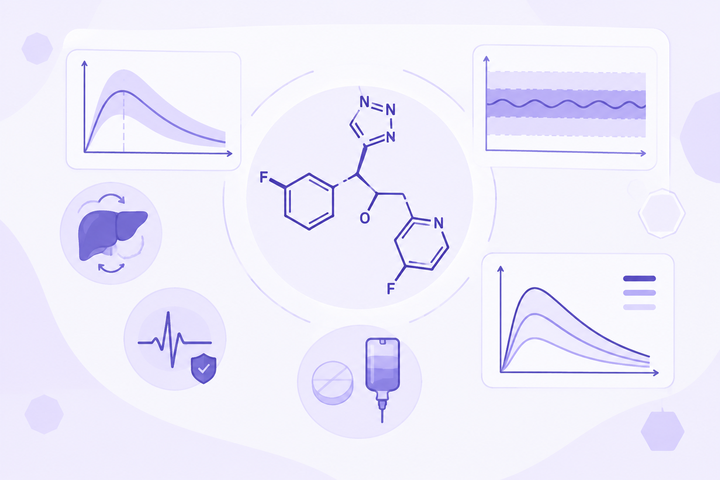
Voriconazole is a second-generation triazole antifungal whose pharmacology can be described through interconnected mechanistic, pharmacokinetic, dosing, safety, interaction, and monitoring layers. At the molecular level, the mechanism centers on inhibition of fungal sterol biosynthesis, while the broader PK/PD framework relates drug exposure to antifungal activity. Its systemic disposition is shaped by metabolism, including substantial involvement of CYP2C19, together with other hepatic enzyme pathways. Pharmacokinetic descriptions also incorporate half-life, Tmax & Cmax, and variability in systemic exposure. These concepts are linked rather than isolated: enzymatic metabolism influences concentration profiles, concentration profiles inform PK/PD interpretation, and PK/PD terminology provides the mechanistic foundation for describing how different dosing structures produce exposure. This hub organizes those relationships as neutral pharmacology concepts rather than treatment instructions.
Voriconazole exists in multiple systemic formulations whose properties add another layer to its pharmacokinetic profile. The tablet, oral suspension, and IV form represent distinct administration formats, while bioavailability describes the extent to which an administered dose becomes systemically available. Formulation characteristics interact with absorption, distribution, hepatic metabolism, and concentration-time behavior, creating a pharmacologic bridge between product form and systemic exposure. Dosing terminology is commonly divided into concepts such as a loading dose and maintenance dose, which describe different phases of exposure establishment and continuation. This overview treats those terms as pharmacokinetic constructs rather than recommendations. The same framework also helps distinguish formulation-related influences from metabolic variability, allowing voriconazole dosing language to be understood in relation to concentration dynamics without presenting patient-specific instructions or clinical decision rules.
The remaining layers of voriconazole pharmacology concern how exposure is documented through safety, interaction, and monitoring terminology. A broad toxicity overview can be subdivided into organ-specific and symptom-based categories, while metabolism-dependent interactions are organized through pathways such as CYP2C19 interactions, CYP3A4 interactions, and CYP2C9 interactions. Monitoring concepts include exposure-oriented TDM and broader monitoring safety terminology. These domains reflect the same underlying pharmacologic system: voriconazole concentrations are influenced by formulation, metabolic capacity, and interacting compounds, while concentration variability can intersect with documented efficacy and safety observations. Presented together, mechanism, PK/PD, dosing structure, adverse-effect terminology, interaction pathways, and monitoring concepts form a unified overview of how voriconazole is characterized in pharmacology and clinical documentation without providing individualized medical guidance.
Voriconazole acts through a fungal sterol-synthesis pathway that forms the foundation of its mechanism. As a triazole antifungal, it inhibits fungal cytochrome P450-dependent 14-alpha-sterol demethylation, disrupting ergosterol formation and altering fungal membrane composition. This molecular process connects directly with the broader PK/PD framework because antifungal effect is interpreted in relation to systemic exposure. Pharmacodynamic terminology therefore links target inhibition, concentration patterns, organism susceptibility, and measurable drug exposure without implying a specific therapeutic strategy or individualized treatment approach.
Voriconazole pharmacokinetics are notable for substantial interindividual variability, partly because hepatic metabolism involves polymorphic CYP2C19 activity as well as other oxidative pathways. Concentration-time behavior can be described using parameters including half-life and Tmax & Cmax. These parameters characterize persistence, peak concentration, and time to peak rather than functioning as isolated predictors. Nonlinear pharmacokinetic behavior may also contribute to disproportionate changes in exposure as dose or metabolic conditions change, making systemic concentration an important descriptive component of voriconazole pharmacology.
The relationship between mechanism and systemic exposure is further organized through bioavailability, metabolic clearance, and concentration-response concepts. PK/PD terminology does not describe a single concentration value in isolation; instead, it frames exposure relative to fungal susceptibility and pharmacodynamic effect. Factors associated with CYP2C19 phenotype, hepatic metabolism, formulation, and interacting compounds may alter observed exposure. These features explain why voriconazole documentation often integrates mechanistic information with TDM terminology and other concentration-based descriptors, while remaining conceptually distinct from clinical prescribing or patient-specific interpretation.
Mechanistic Layer
PK/PD Element
Documentation Role
Fungal sterol synthesis inhibition
Target-level antifungal effect
Explains the molecular basis of voriconazole activity
Systemic exposure
Concentration-response relationship
Connects pharmacokinetic exposure with pharmacodynamic effect
Hepatic metabolism
Variable clearance and nonlinear exposure
Provides context for concentration variability
CYP2C19 contribution
Genotype- and phenotype-associated exposure differences
Describes one source of interindividual pharmacokinetic variation
Concentration-time profile
Half-life, Tmax, and Cmax
Characterizes persistence and peak-exposure behavior
Formulations & Bioavailability Overview
Voriconazole is available in oral and intravenous formulations that represent different routes into systemic circulation. The tablet and oral suspension depend on gastrointestinal absorption before reaching systemic circulation, whereas the IV form delivers voriconazole directly into the vascular compartment. These formulations share the same active antifungal compound but differ in administration characteristics. Their pharmacokinetic comparison is primarily expressed through absorption, systemic availability, concentration-time profiles, and formulation-specific excipients rather than through differences in the fundamental antifungal mechanism.
The concept of bioavailability describes the fraction of an administered amount that reaches systemic circulation in an active form. Voriconazole has comparatively high oral systemic availability, allowing oral formulations to produce systemic exposure that can be described alongside intravenous exposure. However, route and formulation remain relevant to absorption-related pharmacokinetic variables, including Tmax & Cmax. Formulation analysis therefore distinguishes the process of drug entry into circulation from subsequent distribution and metabolism, creating a structured view of where pharmacokinetic variability can arise.
Once voriconazole reaches systemic circulation, its later disposition is governed by metabolic and elimination processes rather than formulation alone. Parameters such as half-life, hepatic enzyme activity, and systemic concentration patterns help describe this post-absorption phase. Product identity can also be separated from formulation science through the generic vs brand concept, which concerns marketed versions rather than a different active mechanism. Together, tablet, suspension, intravenous, bioavailability, and product terminology provide a formulation-focused framework that complements the wider PK/PD description of voriconazole.
Formulation
PK Influence
Bioavailability Context
Tablet
Requires gastrointestinal absorption before systemic distribution
Oral systemic availability contributes to concentration exposure
Oral suspension
Requires gastrointestinal absorption and formulation-specific administration characteristics
Provides an oral route to systemic voriconazole exposure
IV formulation
Introduces drug directly into systemic circulation
Does not depend on gastrointestinal absorption
Generic and branded products
Contain the same active antifungal ingredient within regulated product frameworks
Product identity is distinct from the core concept of systemic bioavailability
Dosing Overview
Voriconazole dosing terminology can be divided into exposure-establishment and exposure-maintenance concepts. A loading dose refers to an initial dosing phase designed conceptually to establish systemic concentrations more rapidly, whereas a maintenance dose describes subsequent dosing intended to sustain exposure over time. These terms arise from pharmacokinetic principles involving distribution, clearance, and half-life. They describe structural components of dosing regimens rather than standalone instructions, and their interpretation is inseparable from voriconazole's variable and sometimes nonlinear pharmacokinetic behavior.
Dose-related exposure is also influenced by hepatic metabolic capacity. The hepatic adjustment concept concerns how altered liver function intersects with clearance and systemic concentration because voriconazole undergoes extensive metabolism. By contrast, renal adjustment terminology reflects the distinction between elimination of unchanged active drug and formulation-specific considerations associated with renal function. These categories are documentation frameworks used to explain why organ function may be discussed alongside dosing, rather than universal dosing rules or individualized prescribing directions.
The pharmacologic rationale underlying dosing terminology is closely linked to PK/PD, bioavailability, and concentration variability. Oral and intravenous dosing can be compared through systemic exposure rather than simply through administered amount, while metabolic pathways including CYP2C19 can contribute to differences in observed concentrations. Exposure-focused concepts such as TDM are therefore often discussed in the same documentation environment as loading, maintenance, hepatic, and renal terminology. Together, these elements describe how dosing structure relates mechanistically to pharmacokinetics without supplying a recommended regimen.
Dosing Element
PK/PD Rationale
Documentation Context
Loading dose
Conceptually establishes systemic exposure more rapidly
Describes the initial phase of a dosing structure
Maintenance dose
Relates repeated administration to ongoing exposure and clearance
Describes the continuing phase of a dosing structure
Hepatic adjustment
Reflects the relationship between hepatic function and metabolic clearance
Distinguishes active-drug disposition from renal and formulation considerations
Provides renal-function context within dosing documentation
Exposure assessment
Connects administered dosing with measured systemic concentration
Links dosing terminology with PK/PD and TDM concepts
Safety Overview
Voriconazole safety terminology spans expected adverse-effect patterns and less common organ-specific toxicities. A broad toxicity overview organizes these observations by affected system, frequency category, mechanistic plausibility, and relationship to systemic exposure. The common side effects category describes frequently documented reactions, whereas serious side effects groups clinically significant events within formal safety documentation. These categories summarize observed pharmacologic effects and regulatory safety terminology without functioning as instructions about treatment continuation, interruption, or individual risk management.
Several recognizable voriconazole-associated effects are described in organ-specific terms. Hepatotoxicity concerns abnormalities involving hepatic biochemical markers or liver injury patterns in relation to hepatic metabolism and exposure. Visual disturbances describe transient visual phenomena documented with voriconazole exposure, while photosensitivity concerns heightened cutaneous response to ultraviolet radiation. These phenomena differ mechanistically and clinically, so safety documentation separates them rather than treating toxicity as a single uniform process. Their occurrence can also be considered within broader concentration, duration, and host-factor frameworks.
Safety descriptions frequently intersect with pharmacokinetics because systemic concentration is influenced by metabolism, nonlinear exposure, and enzyme variability. This relationship explains why adverse-effect terminology can appear alongside TDM, LFTs, ECG monitoring, and skin monitoring in pharmacology references. These monitoring categories correspond to different domains of documented exposure or organ effects. They are best understood as structured observational frameworks connecting pharmacokinetic variability with laboratory, electrophysiologic, dermatologic, or concentration data rather than as individualized safety directions.
Safety Category
Mechanistic Context
Documentation Role
General adverse effects
Pharmacologic and exposure-related effects across organ systems
Intersects with hepatic metabolism and biochemical liver changes
Separates liver-related findings from other toxicity categories
Visual effects
Associated with characteristic transient visual phenomena
Defines a recognizable voriconazole adverse-effect category
Photosensitivity
Represents a cutaneous response associated with light exposure
Provides a distinct dermatologic safety category
Electrophysiologic effects
Relates cardiac electrical parameters to systemic drug effects
Provides context for ECG-associated safety documentation
Interactions & Monitoring Overview
Voriconazole has a complex interaction profile because it is both metabolized by and capable of influencing multiple cytochrome P450 pathways. CYP2C19 interactions, CYP3A4 interactions, and CYP2C9 interactions describe different enzymatic mechanisms through which coadministered compounds may alter voriconazole exposure or experience altered exposure themselves. Interaction terminology therefore includes inhibition, induction, substrate competition, and bidirectional pharmacokinetic effects. These mechanisms provide the foundation for interpreting drug-interaction documentation without reducing every interaction to a single uniform change in concentration.
Named interaction pages illustrate how enzyme-mediated effects differ among coadministered agents. Tacrolimus and cyclosporine are commonly discussed in relation to CYP-mediated exposure changes involving immunosuppressant concentrations, while warfarin represents an interaction context involving anticoagulant pharmacology and metabolic pathways. The mechanistic basis of these interactions can involve inhibition of drug clearance, altered concentration-time profiles, or changes in pharmacodynamic markers. Their inclusion in a voriconazole overview demonstrates how metabolic pharmacology links antifungal exposure with the disposition of other compounds.
Monitoring terminology provides a framework for documenting concentration and organ-system observations associated with voriconazole pharmacology. Monitoring safety functions as the broad category, while TDM refers specifically to measured drug concentrations. LFTs represent hepatic laboratory markers, ECG monitoring concerns cardiac electrical parameters, and skin monitoring describes dermatologic observation. These domains can be documented alongside interaction and metabolism data because altered exposure may intersect with laboratory or concentration findings, creating an integrated pharmacokinetic and safety-monitoring vocabulary.
Interaction Class
Mechanistic Basis
Monitoring Context
CYP2C19 interactions
Altered metabolism through a major voriconazole metabolic pathway
Can be contextualized with systemic concentration data
CYP3A4 interactions
Enzyme inhibition, substrate effects, or induction involving CYP3A4
May be documented alongside concentrations of interacting compounds
CYP2C9 interactions
Metabolic inhibition or substrate-related exposure changes
Can intersect with pharmacodynamic laboratory markers
Immunosuppressant interactions
Reduced metabolic clearance of susceptible coadministered substrates
Often described using drug-exposure monitoring terminology
Safety monitoring domains
Observation of concentration, hepatic, electrical, or dermatologic parameters
Includes TDM, LFT, ECG, and skin-related documentation
Frequently Asked Questions
Voriconazole is a triazole antifungal that inhibits a fungal cytochrome P450-dependent enzyme involved in conversion of lanosterol toward ergosterol. Reduced ergosterol synthesis changes fungal cell-membrane composition and function. This mechanism distinguishes the drug's molecular target from its later pharmacokinetic processes, such as absorption, metabolism, distribution, and elimination. Mechanism descriptions therefore explain how voriconazole affects fungal biology, while PK/PD terminology describes how systemic exposure relates to the resulting antifungal effect.
PK/PD combines pharmacokinetics, which describes what happens to voriconazole in the body, with pharmacodynamics, which describes the relationship between exposure and antifungal effect. Pharmacokinetic variables include absorption, bioavailability, distribution, metabolism, concentration-time behavior, and elimination. Pharmacodynamic interpretation adds organism susceptibility and exposure-response relationships. Voriconazole is notable for substantial variability in systemic concentrations, so PK/PD discussions commonly integrate metabolic capacity, nonlinear pharmacokinetics, formulation characteristics, and measured exposure into a single conceptual framework.
Voriconazole is formulated for oral and intravenous administration. Oral products include tablets and an oral suspension, both of which require absorption through the gastrointestinal tract before systemic distribution. The intravenous formulation introduces the active drug directly into systemic circulation and therefore bypasses gastrointestinal absorption. Although the formulations differ in route, administration characteristics, and some formulation-specific properties, they contain the same active antifungal compound. Their comparison is mainly expressed through bioavailability, absorption characteristics, concentration profiles, and formulation-related pharmacokinetic terminology.
Loading dose and maintenance dose are pharmacokinetic terms describing different phases of a dosing structure. A loading phase is conceptually associated with establishing systemic drug exposure more rapidly, while a maintenance phase refers to subsequent administration intended to sustain exposure as drug distribution and clearance continue. For voriconazole, these concepts are discussed alongside nonlinear pharmacokinetics, metabolic variability, bioavailability, and organ-function terminology. They describe how dosing structures relate to concentration over time rather than constituting individualized dosing recommendations.
Voriconazole safety terminology includes broad adverse-effect categories as well as organ-specific or symptom-specific effects. Commonly documented categories include hepatic effects, visual disturbances, dermatologic photosensitivity, and other systemic adverse events. Safety references may distinguish frequent effects from less common but clinically significant findings and may describe associations with exposure, treatment duration, metabolism, or host characteristics. These terms provide a structured vocabulary for characterizing observed effects of voriconazole without determining how any particular patient's findings should be interpreted.
Voriconazole interaction terminology primarily describes changes in drug metabolism or exposure caused by cytochrome P450 pathways. Voriconazole is metabolized through enzymes including CYP2C19, CYP3A4, and CYP2C9 and can also inhibit metabolic pathways affecting other compounds. Interactions may therefore be described as inhibition, induction, substrate competition, altered clearance, or bidirectional exposure changes. Specific interacting drugs can differ substantially in mechanism and consequence, so pharmacology references usually categorize interactions according to enzyme pathway and concentration effects.
Monitoring terminology refers to structured observation of voriconazole exposure or physiologic parameters associated with its pharmacology. Therapeutic drug monitoring describes measurement of systemic drug concentrations, while other monitoring categories may involve hepatic laboratory values, cardiac electrical parameters, or dermatologic observations. These concepts are linked to the drug's variable pharmacokinetics, metabolic interactions, and documented adverse-effect profile. In pharmacology references, monitoring terms describe the types of data that can be observed rather than providing patient-specific instructions or clinical decision thresholds.