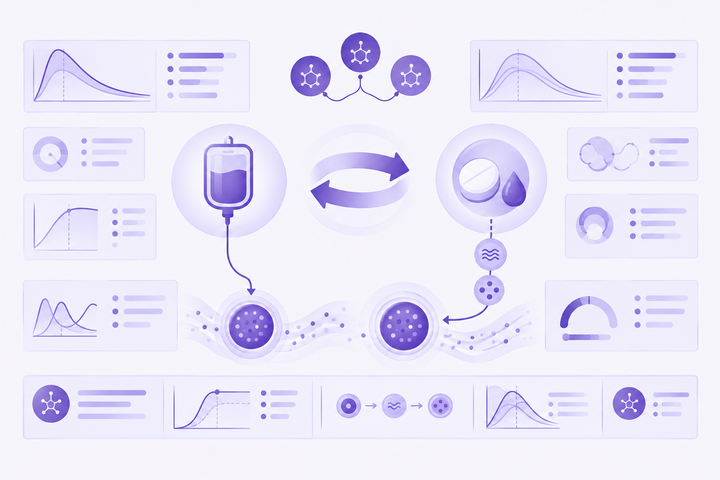
IV ↔ oral switching terminology describes a change in administration route using pharmacokinetic language rather than clinical guidance. An IV formulation provides systemic entry without a gastrointestinal absorption phase, whereas oral formulations require dissolution, gastrointestinal transit, membrane permeation, and presystemic processes before systemic exposure develops. The IV form therefore represents direct systemic input, while the tablet and oral suspension represent extravascular input with formulation-dependent absorption characteristics. Route terminology can be interpreted alongside IV form, tablet, and oral suspension concepts. This framework describes route-dependent exposure pathways without specifying conversion methods, dose ratios, or clinical switching criteria. It instead establishes a neutral vocabulary for discussing how formulation and administration route influence the concentration-time profile and the interpretation of systemic exposure.
Systemic exposure after a route change is shaped by bioavailability, absorption variability, distribution, metabolism, and clearance rather than by route labels alone. Bioavailability describes the fraction of administered drug reaching systemic circulation, while absorption variability describes differences in the rate or extent of gastrointestinal input. Voriconazole also has route-relevant metabolic characteristics involving metabolism and CYP2C19, with phenotype contributing to interindividual exposure variability. Nonlinear kinetics means exposure may not change proportionally with changes in systemic input. Distribution and clearance further shape observed concentrations after absorption or direct systemic entry. These concepts provide a neutral vocabulary for describing route-associated PK differences without implying a particular conversion strategy.
Exposure interpretation also depends on the temporal and disposition descriptors used to characterize concentration profiles. Tmax & Cmax describe the timing and magnitude of observed peak concentrations, whereas half-life describes the rate of concentration decline under defined PK conditions. Clearance connects systemic elimination capacity with concentration-time behavior, while TDM refers to measurement and interpretation of drug concentrations as an exposure descriptor. Route changes can alter the input phase while leaving distribution and elimination processes conceptually distinct. Distribution therefore remains relevant to overall concentration interpretation, alongside toxicity overview terminology, without implying a clinical action. Collectively, these PK descriptors help distinguish absorption-related changes from disposition-related variability when route differences are discussed.
IV vs Oral Foundations: Systemic Entry & Absorption
IV administration represents direct systemic entry because the formulation reaches the circulating compartment without a gastrointestinal absorption step. The IV form therefore has no conventional oral absorption phase. Oral administration uses extravascular input, with the tablet or oral suspension undergoing formulation-dependent dissolution and gastrointestinal processes. These route distinctions establish different input functions in a concentration-time model. Bioavailability is relevant primarily to extravascular administration because systemic availability depends on the fraction reaching circulation.
The distinction between absorption and systemic entry is central to route terminology. IV input bypasses gastrointestinal absorption, while oral input incorporates an absorption process before measurable systemic exposure. The rate and extent of oral absorption can be characterized using absorption variability concepts, whereas subsequent tissue movement is described through distribution. Metabolism represents biotransformation processes that may occur before or after systemic exposure depending on the relevant pathway. These terms describe mechanisms rather than prescribing a preferred route or defining a switching rule.
When IV and oral administration are compared, the principal mechanistic difference concerns the route by which drug enters systemic circulation. Oral formulations introduce an absorption phase, while IV administration provides direct systemic input. The resulting concentration-time profiles can therefore differ in onset characteristics, peak behavior, and apparent exposure even when the same active ingredient is involved. Tmax & Cmax provide temporal and peak descriptors, while half-life describes concentration decline. These measures help separate input characteristics from disposition characteristics in PK descriptions.
Route Element
Mechanistic Basis
Exposure Role
IV formulation
Direct systemic entry without gastrointestinal absorption
Defines systemic input without an absorption phase
Oral tablet
Dissolution followed by gastrointestinal absorption
Bioavailability describes the systemic availability of drug after extravascular administration and is distinct from the mere presence of drug in a dosage form. Bioavailability therefore connects formulation input with systemic exposure. Oral absorption variability can alter the rate or extent of drug reaching circulation, producing differences in concentration-time profiles. The tablet and oral suspension are both oral formulations, but formulation characteristics can influence dissolution and absorption behavior. These concepts remain descriptive rather than prescriptive.
Absorption variability can affect observed peak concentrations and the timing of those peaks without necessarily representing a change in systemic elimination. Tmax & Cmax provide useful descriptors of the temporal and magnitude characteristics of an observed concentration profile. Once drug has entered systemic circulation, distribution and clearance contribute to subsequent concentration behavior. Half-life provides a separate descriptor of concentration decline. Distinguishing absorption from disposition helps characterize route-associated PK differences without assigning clinical significance.
The relationship between route, bioavailability, and systemic exposure is not limited to a single concentration measurement. Exposure may be described through concentration-time behavior, while absorption describes the input process preceding systemic circulation. Bioavailability provides a measure of systemic availability, whereas absorption variability emphasizes interoccasion or interindividual differences. Subsequent metabolism and clearance influence systemic concentrations after entry. Consequently, route comparisons require terminology that separates formulation input, absorption, systemic disposition, and observed exposure.
Absorption/Bioavailability Factor
Mechanistic Link
PK Impact
Bioavailability
Fraction reaching systemic circulation after extravascular administration
Influences overall systemic exposure
Absorption variability
Differences in rate or extent of gastrointestinal input
Can alter concentration-time profiles and peak descriptors
Formulation characteristics
Dissolution and dispersion influence the absorption process
Can contribute to differences in oral input behavior
Tmax and Cmax
Reflect timing and magnitude of observed peak concentration
Voriconazole exposure is also influenced by metabolic processes that remain conceptually distinct from the administration route. Metabolism describes enzymatic biotransformation, while CYP2C19 represents an important pharmacogenetic and metabolic terminology domain. CYP2C19 phenotype can contribute to interindividual differences in metabolic capacity and therefore systemic exposure. During route comparisons, these disposition characteristics may coexist with formulation-dependent absorption differences. The distinction is important because a change in observed concentration can reflect input, metabolism, or both, rather than route alone.
The term nonlinear kinetics describes concentration or exposure behavior that does not change proportionally with systemic input under relevant conditions. For voriconazole, nonlinear PK terminology is therefore important when describing relationships among administration, concentration, metabolism, and clearance. Clearance provides a disposition descriptor linking systemic elimination with concentration-time behavior. Distribution describes movement between systemic circulation and tissues. These mechanisms operate conceptually after systemic entry, while bioavailability and absorption variability primarily describe extravascular input.
CYP2C19 phenotype adds an interindividual dimension to route-related exposure interpretation. Differences in metabolic activity can contribute to variability in concentration-time profiles independently of whether systemic entry occurred intravenously or through gastrointestinal absorption. CYP2C19, metabolism, and nonlinear kinetics therefore belong to the same conceptual PK vocabulary but describe different mechanisms. Route comparison can also reference half-life and clearance when describing disposition. These terms support neutral characterization without defining switching decisions or conversion parameters.
Metabolic Factor
CYP Connection
Route-Exposure Impact
Metabolism
Enzymatic biotransformation contributes to systemic disposition
Can modify exposure independently of route-specific input
CYP2C19 phenotype
Reflects genetically influenced differences in CYP2C19 activity
Can contribute to interindividual exposure variability
Nonlinear kinetics
Exposure may not change proportionally with systemic input
Complicates simple interpretation of route-associated exposure changes
Clearance
Represents systemic elimination capacity
Shapes concentration-time behavior after systemic entry
Tmax & Cmax describe peak timing and peak magnitude, making them useful descriptors when contrasting input characteristics. Route changes can modify the absorption phase for oral administration, whereas IV input does not require gastrointestinal absorption. Half-life describes the decline phase and is conceptually different from absorption rate. Clearance describes systemic elimination, while distribution describes movement between compartments. Together, these terms distinguish input, distribution, and elimination within concentration-time interpretation.
TDM refers to therapeutic drug monitoring as a measurement and interpretation framework for drug concentrations, rather than a route itself. Concentration measurements can provide observed exposure data that are interpreted alongside formulation, administration route, sampling timing, and PK descriptors. Tmax & Cmax, half-life, and clearance describe different dimensions of concentration behavior. Bioavailability and absorption variability add information about extravascular input, creating a broader PK vocabulary.
Toxicity terminology can be discussed separately from route mechanics and should not be treated as a direct synonym for systemic exposure. The toxicity overview domain concerns terminology describing systemic adverse-effect concepts, whereas PK descriptors characterize drug movement and concentration behavior. Metabolism, CYP2C19, and nonlinear kinetics can contribute to exposure variability, while TDM describes concentration measurement and interpretation. This separation keeps route-switching discussions pharmacokinetic and medically neutral without introducing clinical recommendations.
PK/Monitoring Metric
Mechanistic Connection
Documentation Context
Tmax
Time associated with observed peak concentration
Describes temporal characteristics of systemic input
Cmax
Observed maximum concentration
Describes peak magnitude within a concentration-time profile
Half-life
Rate-related descriptor of concentration decline
Characterizes disposition rather than oral absorption
Measurement and interpretation of drug concentrations
Provides observed concentration data for PK documentation
Toxicity terminology
Describes systemic adverse-effect concepts separately from PK mechanics
Provides contextual terminology without implying clinical action
Frequently Asked Questions
IV versus oral terminology identifies the administration route and the corresponding pathway into systemic circulation. IV administration represents direct systemic entry without a gastrointestinal absorption phase. Oral administration involves extravascular input through a formulation such as a tablet or suspension, followed by gastrointestinal absorption. In pharmacokinetic documentation, the distinction describes route-dependent input characteristics and concentration-time behavior. It does not, by itself, specify a conversion method, dosing relationship, or clinical switching decision.
Absorption describes movement of drug from an administration site into systemic circulation, whereas systemic entry is the broader concept of drug reaching the circulating compartment. Oral administration includes an absorption phase because gastrointestinal processes precede systemic exposure. IV administration provides systemic entry directly and therefore does not require gastrointestinal absorption. This distinction is important when interpreting concentration-time profiles because differences in input can affect observed exposure independently of distribution, metabolism, and elimination.
Bioavailability describes the fraction of administered drug that reaches systemic circulation after an extravascular route. It is therefore particularly relevant to oral administration, where formulation dissolution, gastrointestinal absorption, and presystemic processes influence systemic availability. IV administration is conceptually different because the drug enters systemic circulation directly. In route comparisons, bioavailability helps distinguish the amount of administered drug becoming systemically available from other PK characteristics such as clearance, distribution, absorption rate, and concentration-time variability.
CYP2C19 phenotype describes genetically influenced differences in CYP2C19 metabolic activity. Because CYP2C19 participates in voriconazole metabolism, phenotype can contribute to interindividual variability in systemic exposure. This metabolic variability is distinct from formulation-dependent absorption and route-dependent systemic entry. Consequently, two concentration profiles can differ because of metabolic characteristics even when administration conditions are otherwise comparable. CYP2C19 terminology is therefore useful for describing exposure variability without implying a specific dose, conversion method, or clinical decision.
Nonlinear kinetics describes a pharmacokinetic relationship in which exposure does not change proportionally with changes in systemic input under relevant conditions. For voriconazole, this concept means that route-associated changes in systemic input should not automatically be interpreted through a simple proportional model. Metabolic processes and clearance can contribute to the observed relationship between input and concentration. Nonlinear kinetics is therefore a descriptive PK concept that helps explain why concentration-time behavior may be more complex than a straightforward route comparison.
PK interpretation separates administration and absorption characteristics from distribution, metabolism, and elimination. IV administration provides direct systemic entry, whereas oral administration introduces an absorption phase influenced by formulation and bioavailability. Descriptors such as Tmax, Cmax, half-life, and clearance characterize different parts of the concentration-time profile. TDM can provide measured concentration data for documentation and interpretation. A complete PK description therefore considers route, input, disposition, timing, variability, and metabolic factors rather than treating a single concentration value as a complete representation of exposure.