PK terminology • Neutral interpretation

Voriconazole–Warfarin Interaction Terminology & PK Interpretation

Voriconazole–warfarin interaction terminology describes pharmacokinetic relationships between voriconazole exposure, metabolic inhibition, and warfarin-related pharmacology without constituting clinical instruction. Formulation-dependent input can be represented by the tablet, oral suspension, or IV form, while bioavailability and absorption variability describe differences in systemic input. Distribution, metabolism, CYP2C19 phenotype, nonlinear kinetics, and clearance provide mechanistic vocabulary for explaining why measured exposure may vary. Inhibitor terminology is descriptive: it identifies an effect on metabolic pathways rather than prescribing an intervention. Documentation may distinguish systemic exposure from administered formulation and separate observed concentration changes from inferred mechanisms. Relevant descriptors include Tmax and Cmax for concentration-time characteristics, half-life for temporal persistence, and TDM as a measurement framework. These concepts support pharmacokinetic interpretation while remaining separate from dose-adjustment guidance, INR-management recommendations, or clinical decision-making.

Warfarin-interaction interpretation can incorporate formulation-dependent systemic input because oral and intravenous administration represent different routes through which voriconazole reaches the systemic circulation. The tablet and oral suspension introduce oral absorption considerations, whereas the IV form represents systemic input that is less dependent on gastrointestinal absorption. Bioavailability therefore provides terminology for the fraction of administered drug reaching systemic circulation, while absorption variability describes changes in the rate or extent of that input. Distribution terminology concerns movement between plasma and tissues, whereas metabolism and clearance describe processes contributing to concentration decline. CYP2C19 phenotype can be documented as a source of metabolic variability, and nonlinear kinetics can complicate proportional interpretation of concentration changes. Tmax and Cmax describe temporal and peak-exposure features, while half-life describes concentration decline over time. TDM can provide measured concentration information for pharmacokinetic characterization. These descriptors are interpretive constructs and do not specify therapeutic targets, INR actions, dose changes, or management decisions.

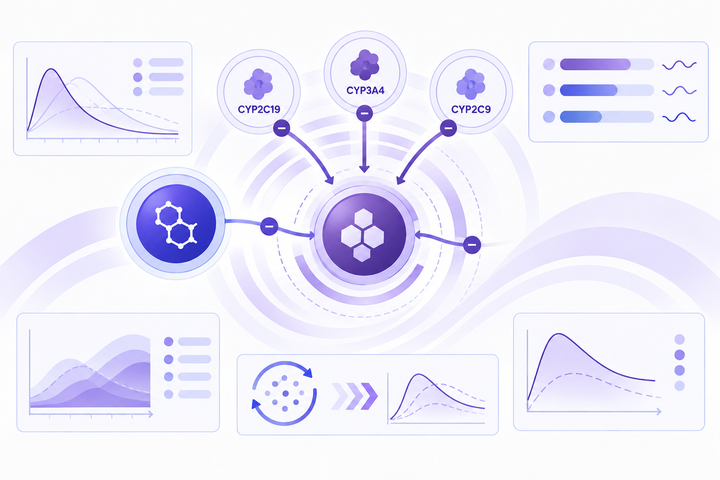
In pharmacokinetic documentation, voriconazole–warfarin interaction terminology can be organized as a sequence from formulation-dependent input through systemic exposure, metabolic pathway interaction, and observed temporal concentration behavior. Oral formulations may introduce variability through bioavailability and absorption, while IV administration provides a distinct systemic-input context. Distribution can modify the relationship between plasma concentration and tissue exposure, and clearance represents the aggregate removal capacity relevant to concentration-time behavior. Metabolism terminology may identify CYP-linked pathways, including CYP2C19-related variability, while inhibitor terminology describes pathway suppression or altered metabolic activity in mechanistic terms. Nonlinear kinetics may make exposure changes disproportionate to changes in input or concentration. Tmax, Cmax, and half-life provide complementary temporal descriptors, and TDM represents a measurement framework for characterizing concentrations rather than a directive for clinical action. This terminology can therefore distinguish measured observations, mechanistic hypotheses, formulation effects, and PK variability without specifying dose adjustment, INR management, risk stratification, or clinical recommendations.

Warfarin-Interaction Terminology Foundations
Warfarin interaction

Warfarin-interaction terminology can be framed around the relationship between co-exposure, metabolic pathways, systemic concentrations, and pharmacokinetic variability. The term interaction describes a measurable or hypothesized relationship between concurrently present substances without specifying a clinical consequence. Exposure terminology includes systemic exposure, plasma concentration, concentration-time profile, peak concentration, and overall exposure over an observation interval. Mechanistic descriptions can distinguish metabolic inhibition from changes in absorption, distribution, or clearance. For voriconazole, formulation-dependent input is relevant because tablet, oral suspension, and IV form represent different routes and conditions for systemic entry. Oral input may be described through bioavailability and absorption variability, while IV input provides a direct systemic-delivery context. Warfarin-related documentation may separately identify metabolic pathway terminology, laboratory descriptors, and pharmacodynamic observations. This separation prevents an exposure observation from being treated as an instruction and allows the underlying PK relationship to remain explicitly descriptive.

Interaction terminology also benefits from distinguishing direct observations from mechanistic inference. A documented change in concentration, exposure, or temporal profile is an observation; attributing that change to metabolic inhibition, altered clearance, or formulation-dependent absorption is a mechanistic interpretation. CYP terminology can identify relevant enzyme pathways without implying that a measured laboratory outcome automatically establishes causality. Inhibitor terminology describes decreased or altered enzyme-mediated metabolic activity, whereas inducer terminology, when used for comparison, describes increased metabolic activity. For warfarin-interaction documentation, the metabolic pathway provides context for interpreting co-exposure while INR can be recorded as a descriptive laboratory measurement rather than a management target. Terms such as exposure variability, interindividual variability, and intraindividual variability identify differences in PK observations across people, observations, or conditions. These distinctions help pharmacokinetic records separate systemic input, disposition, metabolic modulation, and measured endpoints without prescribing an intervention.

The terminology framework can also incorporate concentration-time descriptors that make interaction observations temporally explicit. Tmax identifies the observed time associated with peak concentration, while Cmax identifies the peak measured concentration itself. Half-life describes the temporal decline of drug concentration under the applicable kinetic model and sampling conditions. Clearance summarizes the efficiency of drug removal from the relevant systemic compartment, whereas distribution describes movement between circulating and tissue compartments. Nonlinear kinetics indicates that exposure or concentration may not change proportionally with input because one or more PK processes can become concentration dependent or otherwise nonproportional. TDM terminology refers to concentration measurement used to characterize systemic exposure. None of these descriptors independently defines a clinical action. Within warfarin-interaction documentation, their principal role is to create a structured vocabulary for describing observations, mechanistic hypotheses, formulation effects, and uncertainty.

Interaction Term Mechanistic Basis Exposure Role
Drug interaction Relationship between co-exposed pharmacological substances or pathways Frames observed or hypothesized exposure changes
Metabolic inhibition Reduced or altered enzyme-mediated biotransformation Can describe a mechanistic basis for altered systemic exposure
Systemic exposure Drug presence in the systemic circulation over time Provides an exposure-level description
Formulation-dependent input Differences in route, dosage form, or absorption conditions Defines the context for systemic drug entry
Exposure variability Differences in input, disposition, metabolism, or measurement Characterizes variability between or within observations

Inhibitor Terminology (Mechanistic)

Inhibitor terminology describes a pharmacological substance or process that reduces, alters, or otherwise modulates enzyme-mediated metabolism. In a voriconazole–warfarin context, the term inhibitor can be used to characterize a CYP-linked mechanism rather than a therapeutic recommendation. Mechanistic documentation may distinguish reversible inhibition, time-dependent inhibition, competitive inhibition, noncompetitive or mixed inhibition, and pathway-level inhibition according to the evidence available. These terms refer to different relationships between an inhibitor, enzyme, substrate, and metabolic activity. A mechanistic statement should remain distinct from an exposure observation because enzyme inhibition does not by itself quantify the magnitude of a concentration change in a particular dataset. Exposure also depends on systemic input, bioavailability, absorption variability, distribution, clearance, and other metabolic pathways. Therefore, inhibitor terminology is most precise when it identifies the proposed pathway effect while separately reporting measured concentration or exposure data.

CYP-linked terminology provides additional specificity by identifying the enzyme system involved in metabolism. CYP2C19 can be described as a metabolic pathway associated with voriconazole disposition and phenotype-related variability. Terms such as substrate, inhibitor, enzyme activity, metabolic capacity, intrinsic clearance, and pathway contribution describe different levels of the same mechanistic framework. A substrate is a compound acted upon by an enzyme, while an inhibitor modifies enzyme-mediated activity. The presence of an inhibitor does not establish a fixed relationship between dose input and systemic exposure because other processes may contribute to overall disposition. Nonlinear kinetics can further complicate interpretation when enzyme-mediated processes, transport, or clearance exhibit nonproportional behavior. Accordingly, pharmacokinetic documentation can report inhibitor terminology alongside concentration-time observations, metabolic phenotype descriptors, and formulation details rather than treating any single mechanism as a complete explanation.

In warfarin-interaction documentation, inhibitor terminology may be paired with terms describing hepatic metabolism and metabolic pathway modulation. Hepatic metabolism represents biotransformation occurring within the liver, while pathway inhibition describes altered enzyme-mediated processing. The distinction between mechanistic inhibition and observed exposure is important because measured systemic concentrations reflect the combined effects of input, distribution, metabolism, and clearance. Documentation may therefore state that an inhibitor mechanism is present or proposed while separately reporting Cmax, Tmax, half-life, or other PK parameters. Where concentration monitoring is part of a study framework, TDM can provide measured concentration information for descriptive analysis. INR may appear as a laboratory endpoint associated with warfarin pharmacodynamics, but inhibitor terminology does not itself define an INR interpretation or clinical action. This terminology framework preserves the distinction between biochemical mechanism, PK observation, laboratory measurement, and clinical decision-making.

Inhibitor Term Mechanistic Link PK Interpretation
Competitive inhibition Inhibitor and substrate interact with the same enzyme site or catalytic process Describes a mechanism that can alter apparent metabolic activity
Reversible inhibition Enzyme activity changes through a reversible inhibitor relationship Provides mechanistic context for exposure interpretation
Time-dependent inhibition Inhibition changes with duration of inhibitor-enzyme interaction Introduces a temporal dimension to pathway modulation
CYP inhibition Reduced or altered CYP-mediated metabolic activity Provides a pathway-level explanation for PK variability
Pathway inhibition Alteration of a specified metabolic route Separates mechanism from the total systemic disposition profile

Systemic Exposure Variability

Systemic exposure variability refers to differences in the concentration or exposure profile observed under different physiological, formulation, metabolic, or experimental conditions. In a voriconazole–warfarin documentation context, systemic exposure should be separated from administered formulation because the same nominal input does not necessarily produce an identical concentration-time profile across routes or dosage forms. Tablet and oral suspension terminology introduces an oral absorption context, including bioavailability and absorption variability. IV form terminology represents a different systemic-input pathway. Distribution subsequently influences the relationship between circulating concentrations and tissue compartments. Metabolism and clearance determine the extent and rate of drug removal, while CYP2C19 phenotype can contribute to interindividual variability in metabolic capacity. These factors can coexist, making a single observed concentration change difficult to attribute to one mechanism without supporting evidence. The term variability therefore functions as a descriptive PK construct rather than a statement about clinical significance.

Bioavailability describes the fraction of administered drug that reaches systemic circulation, whereas absorption variability describes differences in the rate or extent of drug movement from the administration site into systemic circulation. These concepts are particularly relevant when comparing oral formulations with IV administration. Tmax and Cmax can reflect differences in the timing and magnitude of systemic input, although both are influenced by disposition and sampling design. Half-life provides information about concentration decline and may reflect the combined influence of distribution and clearance under the applicable kinetic model. Nonlinear kinetics can introduce additional variability when changes in input do not translate proportionally into exposure. In documentation, systemic exposure can therefore be represented using concentration-time profiles, exposure metrics, and population-level variability descriptors. Such terminology allows formulation effects and metabolic effects to be considered separately while recognizing that observed PK parameters are products of interacting processes.

Warfarin-context terminology should preserve the distinction between voriconazole exposure and warfarin-related pharmacodynamic or laboratory observations. A concentration measurement describes systemic drug exposure, whereas an INR value is a laboratory measurement associated with the anticoagulant effect of warfarin and can be recorded as an endpoint without assigning a therapeutic interpretation. Interaction documentation can identify temporal association between concentration profiles and laboratory observations while avoiding causal assumptions unless supported by study design and evidence. Variability may be characterized as interindividual, intraindividual, formulation-dependent, time-dependent, or measurement-related. TDM can provide measured concentration data within a defined sampling framework, while population PK analysis can describe between-subject variability and residual variability. These terms are useful for organizing observations, but they do not establish a clinical threshold, risk category, dose recommendation, or INR-management action.

Exposure Variable Mechanistic Basis Warfarin-Context Role
Bioavailability Fraction of administered drug reaching systemic circulation Defines systemic-input context for oral voriconazole
Absorption variability Differences in rate or extent of gastrointestinal uptake Provides context for oral exposure differences
Cmax Observed peak concentration Describes magnitude of a concentration-time profile
Tmax Observed time associated with peak concentration Describes temporal characteristics of systemic input and disposition
Exposure variability Differences across subjects, conditions, formulations, or observations Documents PK heterogeneity without clinical interpretation

Metabolism, CYP2C19 & Nonlinear Kinetics

Metabolism terminology describes biochemical transformation of a compound into metabolites through enzyme-mediated pathways. Hepatic metabolism is particularly relevant to pharmacokinetic documentation because liver enzyme activity can influence systemic exposure, intrinsic clearance, and the persistence of parent drug. CYP terminology identifies members of the cytochrome P450 enzyme system, while CYP2C19 phenotype terminology describes differences in genetically influenced metabolic activity that may contribute to interindividual variability. In a voriconazole–warfarin context, inhibitor terminology can be used to describe modulation of CYP-linked metabolic activity without translating that mechanism into a clinical instruction. The term substrate identifies a compound undergoing enzyme-mediated metabolism, while pathway contribution indicates the relative role of a metabolic route in overall disposition. These concepts are descriptive and should be interpreted alongside formulation, systemic input, distribution, clearance, and concentration-time data.

Nonlinear kinetics describes pharmacokinetic behavior in which exposure does not change proportionally with changes in input, concentration, or another influencing variable. Nonlinearity can arise from saturable metabolism, capacity-limited transport, concentration-dependent binding, or other processes that alter the relationship between systemic input and disposition. In documentation, nonlinear behavior should be distinguished from ordinary interindividual variability because the former concerns the functional relationship between PK variables, whereas the latter concerns differences among observations or subjects. CYP2C19 phenotype may contribute to differences in metabolic capacity, but phenotype alone does not define the complete systemic exposure profile. Clearance may change with concentration or pathway conditions, and Cmax, Tmax, and half-life can reflect the resulting concentration-time behavior. Accordingly, interaction interpretation benefits from reporting the kinetic model, relevant sampling conditions, formulation, and metabolic terminology separately.

Warfarin-related metabolic terminology can be presented as pathway context rather than therapeutic interpretation. Hepatic metabolism and CYP-linked processes provide mechanistic vocabulary for discussing how voriconazole and warfarin may participate in overlapping or interacting metabolic environments. An inhibitor term can identify altered enzyme activity, while exposure terminology describes the resulting concentration observations when such data are available. If INR is included in documentation, it can be identified as a laboratory measurement associated with warfarin pharmacodynamics without assigning a target, threshold, or management implication. TDM can supplement mechanistic documentation by providing measured concentration values, but measured concentrations remain observations requiring contextual interpretation. This approach keeps CYP2C19 phenotype, nonlinear kinetics, hepatic metabolism, systemic exposure, and laboratory descriptors conceptually distinct while allowing them to be represented within one pharmacokinetic framework.

Metabolic Factor CYP Connection Exposure Impact
Hepatic metabolism Enzyme-mediated biotransformation in the liver Contributes to systemic disposition and clearance
CYP2C19 phenotype Variation in CYP2C19 metabolic activity Can contribute to interindividual PK variability
CYP inhibition Altered enzyme-mediated pathway activity Provides a mechanistic basis for altered exposure interpretation
Intrinsic clearance Capacity of metabolic pathways to remove drug independent of systemic flow considerations Describes metabolic contribution to disposition
Nonlinear kinetics Potential concentration- or capacity-dependent PK processes Creates nonproportional relationships between input and exposure

Distribution, Clearance & Temporal PK Descriptors

Distribution describes movement of drug between the systemic circulation and tissues and helps explain why plasma concentration is not always a direct representation of total body drug content. In pharmacokinetic documentation, distribution can influence the shape of a concentration-time curve, the relationship between early and later concentrations, and the interpretation of terminal phases. Clearance describes the volume of plasma or blood from which drug is removed per unit time under the applicable PK framework and integrates contributions from metabolic and excretory processes. When an interaction modifies metabolic activity, clearance terminology provides a quantitative descriptor for the resulting disposition framework without assigning a clinical consequence. Distribution and clearance should therefore be considered alongside systemic input, bioavailability, absorption variability, formulation, and metabolic phenotype rather than treated as isolated determinants.

Temporal descriptors provide a structured vocabulary for describing when and how concentrations change. Cmax is the observed maximum concentration within a defined sampling profile, while Tmax is the observed time at which that maximum occurs. Half-life describes the time associated with a specified proportional decline in concentration under the applicable kinetic phase or model. These descriptors are influenced by sampling frequency, formulation, absorption, distribution, metabolism, clearance, and kinetic linearity. Consequently, a change in Cmax does not necessarily indicate a corresponding change in total exposure, and a change in half-life does not by itself identify the mechanism responsible. Documentation should retain the distinction between measured PK parameters and inferred mechanisms. TDM terminology can describe the process of obtaining drug concentrations at defined sampling times, providing observational data for concentration-time interpretation without prescribing a clinical action.

Within warfarin-interaction documentation, temporal PK descriptors can be placed alongside laboratory observations such as INR without collapsing pharmacokinetic and pharmacodynamic concepts. INR is a standardized laboratory measurement related to coagulation testing and may appear as a study endpoint associated with warfarin pharmacodynamics. Its presence in a dataset does not, by terminology alone, establish a therapeutic threshold or management requirement. Similarly, a voriconazole concentration, Cmax, Tmax, or half-life represents a PK observation whose interpretation depends on formulation, sampling schedule, assay characteristics, metabolic pathway, and disposition model. Documentation can therefore identify temporal associations while explicitly separating observation, mechanism, and clinical interpretation. This approach supports precise pharmacokinetic language when discussing interaction-related changes in systemic exposure.

PK Descriptor Mechanistic Connection Documentation Context
Distribution Movement between systemic and tissue compartments Describes compartmental behavior and concentration profiles
Clearance Aggregate drug-removal processes Quantifies a component of systemic disposition
Cmax Maximum observed concentration Documents peak exposure within a sampling profile
Tmax Time associated with observed peak concentration Documents temporal characteristics of exposure
Half-life Characteristic concentration-decline interval Describes persistence within an applicable kinetic phase
TDM Measurement of drug concentrations at defined times Provides observational concentration data for PK analysis

Documentation Interpretation Factors (neutral)

Documentation interpretation factors determine how confidently a pharmacokinetic observation can be connected to a proposed interaction mechanism. Formulation is a primary contextual variable because tablet, oral suspension, and IV form represent different systemic-input conditions. Oral formulations require consideration of bioavailability and absorption variability, whereas IV administration establishes a different input pathway. Metabolism, CYP2C19 phenotype, and inhibitor terminology provide mechanistic context for systemic disposition, but their presence does not independently quantify exposure change. Distribution and clearance further shape concentration-time profiles. Nonlinear kinetics can introduce nonproportional relationships that make simple comparisons less informative. Consequently, documentation is strengthened when formulation, sampling conditions, assay information, metabolic terminology, and PK descriptors are explicitly separated rather than combined into a single causal statement.

Measurement context is another important interpretation factor. Cmax and Tmax depend on the sampling schedule and the observed concentration profile, while half-life depends on the kinetic phase or model used for estimation. TDM can provide measured concentration data, but a concentration value is meaningful only within its sampling time, formulation, analytical method, and relevant PK context. Exposure variability can reflect biological differences, formulation differences, metabolic phenotype, adherence to a study protocol, sampling variability, or residual unexplained variability. In a warfarin-interaction dataset, INR may be recorded as a laboratory endpoint associated with pharmacodynamic assessment, while voriconazole concentrations represent PK measurements. These variables can be temporally compared in documentation without assigning a therapeutic interpretation or management action.

Terminology should also distinguish certainty levels. A measured concentration difference is an observation; an identified inhibitor relationship is a mechanistic statement; and a proposed explanation for exposure variability is an interpretation that may depend on additional evidence. Documentation uncertainty can arise from incomplete formulation information, sparse sampling, unknown metabolic phenotype, nonlinear disposition, assay limitations, or concurrent factors affecting systemic exposure. Warfarin-interaction terminology therefore benefits from explicit labels such as observed, estimated, inferred, hypothesized, formulation-dependent, or model-dependent. Such language preserves neutrality and avoids converting pharmacokinetic descriptors into clinical recommendations. The resulting framework can describe systemic exposure, hepatic metabolism, CYP-linked inhibition, distribution, clearance, temporal PK parameters, TDM observations, and INR measurements as distinct information categories.

Interpretation Factor Mechanistic Basis Documentation Role
Formulation Route and dosage-form dependent systemic input Defines the context for exposure comparison
Sampling schedule Timing and density of concentration observations Determines interpretability of temporal PK descriptors
Metabolic phenotype Interindividual differences in enzyme activity Provides context for metabolic variability
Nonlinear kinetics Nonproportional relationship between PK variables Influences model selection and exposure interpretation
Assay characteristics Analytical measurement performance and method Defines the context of observed concentration values
Documentation uncertainty Incomplete or variable information across PK determinants Separates observed findings from mechanistic inference

Frequently Asked Questions

Voriconazole–warfarin interaction terminology describes pharmacokinetic and pharmacodynamic relationships observed or hypothesized during co-exposure. It can include metabolic inhibition, systemic exposure, clearance, concentration-time behavior, and laboratory measurement terminology. The term interaction itself is descriptive and does not specify a dose adjustment, INR-management action, therapeutic threshold, risk category, or clinical decision. Its primary purpose is to organize mechanistic and observational information.

Inhibitor terminology describes modulation of enzyme-mediated metabolism. Terms such as CYP inhibition, competitive inhibition, reversible inhibition, and time-dependent inhibition characterize mechanistic relationships between an inhibitor, enzyme, and substrate. These terms describe biochemical or pharmacokinetic mechanisms rather than management requirements. An inhibitor designation also does not independently quantify systemic exposure or establish the magnitude of an observed warfarin-related laboratory change.

Systemic exposure variability refers to differences in concentration-time profiles or exposure measures across subjects, observations, formulations, or conditions. Potential contributors include bioavailability, absorption variability, distribution, metabolism, CYP phenotype, clearance, sampling design, and nonlinear kinetics. In interaction documentation, variability is a descriptive PK characteristic. It does not by itself establish causality, clinical significance, therapeutic thresholds, or a required intervention.

Hepatic metabolism refers to biochemical transformation occurring through enzyme-mediated processes in the liver. Documentation may describe CYP pathways, substrate relationships, inhibitor effects, intrinsic clearance, and metabolic phenotype as components of this process. Hepatic metabolism contributes to systemic disposition but does not alone determine observed exposure. Interpretation also depends on systemic input, distribution, bioavailability, clearance, formulation, and the applicable pharmacokinetic model.

Nonlinear kinetics describes a situation in which exposure or concentration does not change proportionally with an influencing variable such as systemic input. Possible mechanisms include capacity-limited metabolism, concentration-dependent processes, or other saturable pathways. In documentation, nonlinear behavior can affect interpretation of concentration and exposure relationships. It is a PK descriptor rather than a clinical instruction and does not establish an appropriate therapeutic action.

Temporal PK descriptors characterize when and how concentrations change. Cmax identifies the observed peak concentration, Tmax identifies the associated time, and half-life describes concentration decline within an applicable kinetic phase or model. These parameters depend on formulation, absorption, distribution, metabolism, clearance, and sampling design. They provide structured descriptions of concentration-time behavior without independently defining clinical consequences, treatment targets, or management decisions.

Documentation uncertainty can be represented by distinguishing measured observations from estimated parameters and mechanistic hypotheses. Factors such as sparse sampling, incomplete formulation information, unknown metabolic phenotype, assay characteristics, nonlinear disposition, and concurrent influences can limit interpretation. Terms such as observed, estimated, inferred, hypothesized, formulation-dependent, and model-dependent help preserve these distinctions. This approach prevents uncertain PK interpretations from being presented as definitive clinical conclusions.

Formulation terminology identifies differences in systemic input associated with tablet, oral suspension, or IV form and can affect interpretation of bioavailability, absorption, and exposure. INR terminology refers to a laboratory measurement associated with coagulation assessment in warfarin-related documentation. Both are descriptive categories. Neither formulation terminology nor an INR value, considered alone, specifies dose adjustment, a therapeutic threshold, or an INR-management recommendation.

Mayo Clinic — Voriconazole Overview EMA — Voriconazole (VFEND) EPAR MedlinePlus — Voriconazole Drugs.com — Voriconazole Monograph PubMed — Voriconazole Studies