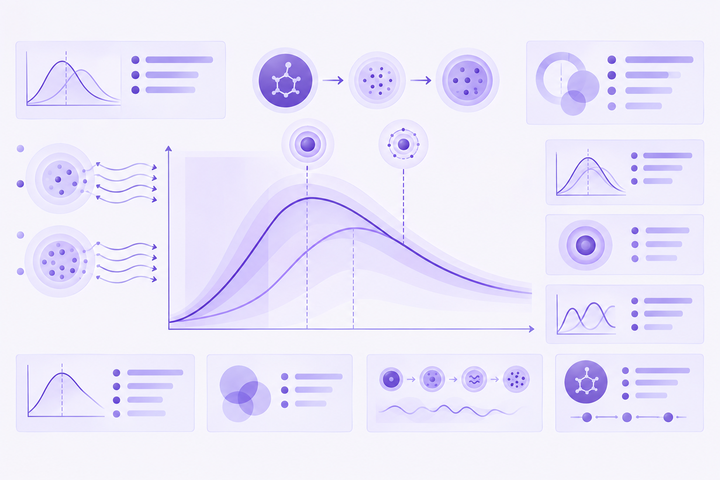
Voriconazole Onset with Food — PK Terminology & Exposure Interpretation
Food-effect onset terminology describes pharmacokinetic changes in the appearance of voriconazole in systemic circulation when administration conditions differ by the presence or composition of food. It is a descriptive PK framework, not a clinical instruction. Absorption-onset terminology refers to the early input phase from an orally administered formulation, while fatty-meal terminology identifies a standardized food condition used to characterize formulation-dependent input. Food can modify the rate and extent of absorption, thereby influencing bioavailability and absorption variability. These concepts are distinct from any claim about symptom response or therapeutic effect. For documentation, onset with food is therefore interpreted through measurable concentration-time behavior rather than a recommended administration schedule. The relevant formulation context includes the voriconazole tablet, oral suspension, and IV form, with the latter providing a non-enteral reference for input and helping distinguish gastrointestinal absorption from post-absorption disposition processes. This terminology is useful for comparing controlled PK conditions and documenting formulation-specific input characteristics without implying a preferred administration pattern.
Food-related PK interpretation connects formulation-dependent absorption with systemic exposure. Oral food effects may be described through changes in bioavailability, absorption variability, and concentration-time descriptors, while an IV form separates gastrointestinal absorption from subsequent distribution, metabolism, and clearance. A fatty meal is a controlled descriptive condition rather than guidance about food selection or timing. Interpretation can incorporate bioavailability, absorption variability, distribution, and metabolism. Voriconazole disposition is also influenced by CYP2C19 phenotype, nonlinear kinetics, and clearance, so an apparent food-associated change in onset may reflect interacting PK processes rather than absorption alone. Consequently, food-effect terminology should be treated as one component of an integrated concentration-time framework that separates input, distribution, biotransformation, and elimination descriptors. This integrated approach helps separate a food-associated absorption observation from broader sources of between-subject or within-subject PK variability in concentration data.
Tmax and Cmax provide descriptive markers for concentration-time behavior, while half-life characterizes the terminal disposition phase and should not be equated with absorption onset. Therapeutic drug monitoring, or TDM, can provide concentration data for PK characterization without implying a particular timing action or clinical threshold. In documentation, Tmax & Cmax can describe changes in peak timing or magnitude, half-life can contextualize persistence, and TDM can contextualize observed concentrations. CYP2C19 phenotype, nonlinear kinetics, and clearance further qualify interpretation. These descriptors support neutral PK documentation and do not establish onset-to-effect relationships, dosing instructions, food-timing recommendations, therapeutic thresholds, or clinical decisions. They instead provide terminology for describing observed systemic exposure and its variability. The same framework can describe concentration observations across formulations and study conditions while preserving the distinction between pharmacokinetic measurement and clinical interpretation.
Food-effect terminology describes how the presence, absence, or composition of food is incorporated into a PK study or documentation set. Absorption onset refers to the early appearance of drug input following oral administration, while food-effect onset describes differences in that input under defined food conditions. A fatty meal is a standardized descriptive condition used to characterize formulation-dependent absorption rather than a recommendation. For voriconazole, the tablet and oral suspension represent enteral formulations, whereas the IV form bypasses gastrointestinal absorption. This vocabulary supports consistent PK reporting across controlled food conditions and formulation comparisons.
The mechanistic distinction between input and disposition is central to neutral interpretation. Food may alter gastric emptying, gastrointestinal conditions, dissolution, or other determinants of oral input, producing observable changes in concentration-time profiles. Such changes are described using bioavailability and absorption variability terminology rather than clinical onset claims. The IV form can serve as a conceptual non-enteral comparator because systemic exposure after intravenous input is not dependent on gastrointestinal absorption. This separation helps documentation distinguish formulation effects from later PK processes. It also preserves the distinction between absorption input and later disposition when concentration changes are described.
Food-effect terminology therefore belongs within a broader PK framework that includes distribution, metabolism, and elimination. Apparent changes in absorption onset should not automatically be interpreted as isolated absorption phenomena, because observed concentrations reflect multiple sequential processes. Descriptors such as Tmax & Cmax can characterize concentration-time differences, while half-life provides terminal disposition context. The terminology remains descriptive: it does not establish food-timing actions, onset-to-effect relationships, or clinical decisions. These concepts are useful for organizing concentration-time observations without translating them into administration or treatment instructions.
Food-Effect Term
Mechanistic Basis
Exposure Role
Food effect
Difference in PK observations between defined food conditions
Characterizes changes in systemic exposure or concentration-time behavior
Absorption onset
Early phase of oral drug input into systemic circulation
Describes the initial portion of the concentration-time profile
Fatty meal
Standardized high-fat food condition used in PK characterization
Defines an experimental condition for comparing exposure or input
Formulation-dependent input
Differences in dosage-form properties and gastrointestinal handling
Helps distinguish formulation effects from disposition processes
Bioavailability describes the fraction or relative extent of administered drug reaching systemic circulation, with oral bioavailability incorporating formulation and absorption processes as well as presystemic loss. Food-effect studies can therefore identify changes in exposure that are expressed through bioavailability-related terminology. For voriconazole, interpretation may distinguish the oral tablet or oral suspension from the IV form, which provides a conceptual reference for systemic input. The term does not itself specify whether an observed difference is clinically important. The distinction is especially useful when multiple sources of variability coexist within a concentration dataset.
Absorption variability refers to differences in the rate or extent of oral drug input across conditions, observations, or individuals. Food can contribute to such variability through effects on gastrointestinal physiology and formulation behavior, but observed concentration variability can also arise from disposition. Absorption variability is therefore interpreted alongside bioavailability, Tmax & Cmax, and systemic exposure measures. Distribution and clearance provide additional context when concentration-time profiles differ between food conditions. This helps prevent an exposure observation from being attributed to food without considering formulation and disposition factors.
A food-associated exposure difference can be represented as a change in peak concentration, peak timing, total exposure, or another PK descriptor, depending on the study design. These observations should be kept separate from claims about therapeutic response. Metabolism can influence systemic concentrations after absorption, while CYP2C19 phenotype can add interindividual and concentration-dependent variability. Consequently, food-effect interpretation is strongest when input-related findings are considered together with formulation, disposition, and exposure descriptors. Such descriptions can support comparative PK reporting across defined study conditions without implying a preferred food relationship.
Absorption/Bioavailability Factor
Mechanistic Link
PK Interpretation
Bioavailability
Extent of systemic entry relative to an appropriate reference
Describes exposure differences associated with oral input
Absorption variability
Variation in rate or extent of gastrointestinal drug input
Qualifies heterogeneity in concentration-time profiles
Food condition
Changes in gastrointestinal environment and formulation behavior
Provides a defined condition for comparative PK analysis
Peak behavior
Combined effects of absorption and disposition
May be represented through changes in peak concentration or timing
Metabolism, CYP2C19 Phenotype & Nonlinear Kinetics in Food-Effect PK
Voriconazole metabolism is an important component of food-effect PK interpretation because systemic concentrations reflect both absorption and subsequent biotransformation. Metabolism terminology describes drug transformation after systemic entry, whereas CYP2C19 identifies a major metabolic pathway relevant to interindividual PK differences. A food-associated change in an oral concentration-time profile can therefore coexist with metabolic variability. The presence of food does not by itself establish that metabolism caused an observed onset difference, so mechanistic attribution requires appropriate PK evidence. This distinction supports neutral interpretation of concentration data when food conditions and phenotype characteristics are evaluated together.
CYP2C19 phenotype terminology describes genetically associated differences in metabolic capacity categories, which can contribute to variation in voriconazole exposure. This variability can complicate comparisons of food-effect conditions because two observations with similar absorption input may still produce different systemic concentrations. Clearance provides a complementary descriptor of drug elimination from the systemic circulation. Nonlinear kinetics further indicates that exposure relationships may not remain proportional across examined conditions, making simple attribution of concentration changes to food alone potentially incomplete. Accordingly, phenotype is an explanatory covariate rather than a substitute for direct absorption measurements in a food-effect analysis.
The distinction between absorption and disposition is particularly important when interpreting onset terminology. An apparent shift in Tmax & Cmax may reflect altered absorption input, while systemic exposure can also be shaped by metabolism and clearance. Bioavailability and absorption variability describe input-related concepts, whereas distribution and half-life add post-absorption context. Thus, CYP2C19 phenotype and nonlinear kinetics should be treated as interpretive qualifiers rather than evidence of a direct food-to-metabolism mechanism. The resulting interpretation remains focused on measurable PK relationships rather than clinical outcomes or dosing decisions.
Metabolic Factor
CYP Connection
Food-Exposure Impact
Metabolism
Includes CYP-mediated biotransformation pathways
Can influence systemic concentrations after absorption
CYP2C19 phenotype
Genetically associated variation in metabolic activity
Can contribute to interindividual exposure variability
Clearance
Reflects overall systemic elimination processes
Can modify concentration profiles independently of oral input
Nonlinear kinetics
May involve concentration-dependent PK behavior
Can complicate direct attribution of exposure differences to food
Tmax and Cmax are concentration-time descriptors commonly used to characterize peak behavior. In food-effect documentation, changes in these measures can indicate differences in the observed absorption profile without implying a clinical onset or effect relationship. Tmax & Cmax can be considered alongside bioavailability and absorption variability. Because peak descriptors represent the combined result of input and disposition, interpretation should also consider formulation and systemic PK processes rather than treating either metric as a standalone measure of absorption. These measures describe observed concentration behavior and should not be interpreted as direct indicators of clinical onset.
Half-life describes the terminal decline of drug concentration and is therefore conceptually distinct from absorption onset. Half-life can help contextualize persistence in a concentration-time profile, while clearance characterizes elimination capacity and distribution describes movement between systemic and tissue compartments. Metabolism can influence these disposition characteristics. In food-effect interpretation, these terms help separate early input phenomena from later concentration behavior without creating timing or treatment recommendations. This distinction is important when peak behavior is discussed alongside food-effect findings and formulation-dependent input.
TDM, or therapeutic drug monitoring, can be described as a source of measured concentration data for pharmacokinetic characterization. In documentation, TDM may be considered with Tmax & Cmax when describing observed variability. A toxicity overview provides terminology for adverse-exposure concepts but does not convert PK measurements into clinical thresholds. Integrated interpretation can also include nonlinear kinetics and metabolism, while remaining strictly descriptive and non-prescriptive. The metric therefore supplies disposition context without specifying any action based on measured concentrations.
PK/Monitoring Metric
Mechanistic Connection
Documentation Context
Tmax
Time-associated descriptor of observed peak concentration
Characterizes peak timing within a concentration-time profile
Cmax
Observed maximum concentration
Describes peak magnitude without implying clinical effect
Half-life
Terminal concentration decline
Provides persistence and disposition context
Clearance
Systemic elimination capacity
Helps contextualize concentration differences after absorption
TDM
Measured drug concentrations used for PK characterization
Provides observational concentration data without establishing therapeutic thresholds
Toxicity terminology
Conceptual relationship between exposure and adverse-exposure descriptions
Supports neutral terminology without clinical decision-making
Frequently Asked Questions
Food-effect terminology is a pharmacokinetic vocabulary for describing how food conditions are associated with differences in drug input or systemic exposure. It can include terms such as food effect, fed condition, fasting condition, fatty meal, absorption onset, bioavailability, and concentration-time profile. The terminology is descriptive and depends on the study design, formulation, and measured PK endpoints. It does not inherently describe clinical response, establish a preferred administration pattern, or provide instructions about food timing.
Absorption-onset terminology refers to the early phase in which drug enters systemic circulation after oral administration. In PK documentation, onset can be characterized through concentration-time observations and related descriptors rather than through symptom changes. Food may alter the rate or extent of oral input, but an observed change in an absorption-related metric does not by itself establish a clinical onset relationship. Interpretation should distinguish absorption processes from distribution, metabolism, and elimination that also shape measured concentrations.
Bioavailability describes the fraction or relative extent of administered drug that reaches systemic circulation, depending on the reference and study design. For oral formulations, it can reflect formulation behavior, gastrointestinal absorption, and presystemic processes. A food effect may be expressed as a change in exposure or a bioavailability-related comparison, but the term does not specify why the difference occurred without supporting mechanistic evidence. Bioavailability therefore functions as an exposure descriptor rather than a clinical effectiveness measure.
Absorption variability refers to differences in the rate or extent of drug input associated with individuals, conditions, formulations, or study occasions. Food can be one source of altered oral absorption characteristics, while formulation properties and physiological variability can also contribute. In voriconazole PK interpretation, absorption variability is best considered alongside concentration-time measures and systemic disposition descriptors. The term describes observed pharmacokinetic heterogeneity and does not itself establish a preferred food condition, timing strategy, or clinical action.
CYP2C19 phenotype terminology describes genetically associated categories of metabolic activity that can contribute to interindividual differences in voriconazole pharmacokinetics. Because systemic exposure reflects both absorption and disposition, phenotype differences can complicate interpretation of concentration profiles observed under different food conditions. CYP2C19 phenotype is therefore an interpretive factor rather than a direct measure of food effect. PK documentation can describe phenotype-associated variability while keeping it distinct from formulation-dependent absorption and from any clinical recommendation.
PK interpretation integrates concentration-time observations with formulation, absorption, distribution, metabolism, and elimination concepts. For food-effect documentation, measures such as Tmax, Cmax, total exposure, bioavailability, and variability can characterize observed differences without assigning clinical meaning to them. Half-life and clearance provide additional disposition context, while CYP2C19 phenotype and nonlinear kinetics can explain some variability. The resulting interpretation should remain tied to the study design and measured data rather than becoming dosing, timing, therapeutic, or treatment guidance.