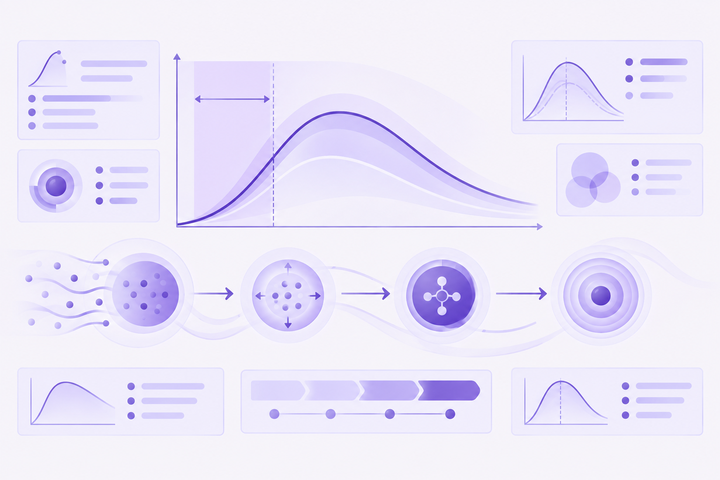
Voriconazole onset terminology can be treated as a pharmacokinetic documentation concept describing the emergence of measurable systemic drug exposure after an administration event, without equating PK onset with clinical effect. Absorption-onset terminology is specifically descriptive of the beginning of drug entry after extravascular administration. Formulation influences this framework because tablet and oral suspension involve gastrointestinal input, whereas IV form introduces drug directly into the systemic circulation without an absorption phase. Bioavailability describes the fraction reaching systemic circulation, while absorption variability describes differences in absorption behavior. These concepts allow onset terminology to remain descriptive and PK-focused rather than becoming guidance about onset-to-effect relationships, timing actions, or clinical decisions.
Onset-related PK interpretation reflects the interaction of input and disposition. Distribution describes movement between systemic and tissue compartments, while metabolism contributes to drug disposition after systemic entry. CYP2C19 phenotype can contribute to interindividual variability in metabolic characteristics, and nonlinear kinetics provides terminology for concentration-dependent departures from proportional relationships. Clearance describes the relationship between systemic elimination and circulating exposure. Consequently, onset terminology does not represent a single mechanistic event; it can reflect formulation, absorption, distribution, metabolism, and elimination characteristics that collectively shape concentration-time observations.
PK descriptors provide a structured vocabulary for documenting onset-related concentration-time behavior without specifying clinical actions. Tmax & Cmax describe the timing and magnitude of an observed concentration peak, while half-life characterizes apparent concentration decline during a defined terminal phase. TDM terminology concerns measurement and interpretation of drug concentrations within pharmacokinetic documentation. These descriptors can be considered alongside toxicity overview terminology when discussing exposure-related concepts, while remaining separate from onset-to-effect claims, therapeutic thresholds, timing recommendations, or clinical decision-making.
In pharmacokinetic documentation, onset terminology can describe the emergence of systemic drug concentrations following an administration event. Absorption onset is narrower, referring to the beginning of drug entry from an extravascular site into systemic circulation. A tablet and oral suspension involve gastrointestinal absorption, whereas an IV form does not have an absorption phase in the conventional sense. Thus, onset terminology depends partly on the formulation-dependent input pathway being described.
The distinction between input and exposure is central to onset interpretation. Bioavailability describes the fraction of administered extravascular drug reaching systemic circulation, while absorption variability describes differences in the rate or extent of absorption. After systemic entry, distribution describes movement among compartments. These concepts mean that an onset descriptor does not represent a single universal timestamp or imply an onset-to-effect relationship. It instead identifies a feature of the observed pharmacokinetic concentration-time process.
Additional disposition terminology helps contextualize onset observations. Metabolism and clearance influence concentrations after systemic entry, while nonlinear kinetics describes departures from proportional relationships between input and exposure. A formulation-specific onset description can therefore be integrated with broader PK terminology without implying clinical timing guidance. The purpose is to document mechanistic relationships among formulation, systemic input, concentration-time behavior, and disposition rather than to define therapeutic or clinical actions.
Onset Term
Mechanistic Basis
Exposure Role
Onset
Emergence of measurable systemic drug exposure after an administration event
Describes an early feature of concentration-time behavior
Absorption onset
Beginning of drug entry from an extravascular site into systemic circulation
Characterizes the start of the absorption process
Formulation-dependent input
Different administration forms create different systemic input pathways
Provides context for interpreting concentration-time profiles
Systemic exposure onset
Initial appearance of drug within the systemic circulation
Separates systemic appearance from clinical effect terminology
For extravascular formulations, bioavailability connects administered input with systemic exposure. A tablet or oral suspension must undergo gastrointestinal input before systemic concentrations can be characterized. Absorption variability can alter the rate or extent of that input, producing differences in concentration-time profiles. Consequently, absorption onset is a mechanistic descriptor of systemic entry rather than a statement about clinical effect, symptom change, or therapeutic timing.
The concentration-time profile can be characterized using Tmax & Cmax, which describe the timing and magnitude of an observed peak. Changes in absorption rate can influence the shape and timing of the profile, while changes in systemic availability can influence exposure more broadly. The IV form provides a contrasting pathway because gastrointestinal absorption is absent. These distinctions support documentation that separates formulation, absorption, systemic entry, and subsequent disposition.
Onset-related exposure interpretation can also incorporate distribution and clearance. Distribution affects the relationship between circulating concentrations and movement into other compartments, while clearance describes systemic elimination relative to circulating exposure. Half-life provides a descriptor of concentration decline during a defined terminal phase. Together, these concepts allow absorption onset and early exposure to be documented without specifying timing actions, onset-to-effect relationships, or clinical recommendations.
Absorption/Bioavailability Factor
Mechanistic Link
PK Interpretation
Bioavailability
Fraction of extravascular input reaching systemic circulation
Separates administered input from systemic input
Absorption onset
Beginning of gastrointestinal drug entry into systemic circulation
Describes an early phase of extravascular input
Absorption rate
Determines the rate at which drug enters systemic circulation
Can influence concentration-time shape and peak timing
Absorption variability
Differences in rate or extent of systemic entry
Can contribute to interindividual and intraindividual PK variability
Metabolism, CYP2C19 Phenotype & Nonlinear Kinetics in Onset PK
Metabolism contributes to the disposition phase that follows systemic drug entry and therefore provides context for interpreting concentration-time observations after onset. CYP2C19 phenotype represents one source of interindividual metabolic variability. Differences in metabolic characteristics can influence circulating concentrations even when formulation and input pathways are similar. Onset terminology therefore describes only part of the PK profile and should not be treated as a complete representation of subsequent exposure or disposition.
Nonlinear kinetics describes situations in which changes in input and exposure are not proportional across the observed concentration range. This concept can affect interpretation when concentration-time behavior departs from a simple linear PK model. Clearance describes the relationship between systemic elimination and circulating exposure, while half-life describes apparent concentration decline during a defined terminal phase. These descriptors provide complementary information about disposition after systemic entry.
CYP2C19-associated variability can be integrated with formulation and absorption terminology rather than interpreted in isolation. Bioavailability determines the fraction of extravascular input reaching systemic circulation, while absorption variability can influence the early concentration-time profile. Distribution further describes movement between compartments after systemic entry. This framework keeps onset PK interpretation mechanistic and descriptive, avoiding onset-to-effect claims, clinical thresholds, timing instructions, or therapeutic decision-making.
Metabolic Factor
CYP Connection
Onset-Exposure Impact
Metabolic capacity
Includes CYP-mediated biotransformation characteristics
Can influence concentrations following systemic entry
CYP2C19 phenotype
Represents variation in CYP2C19-associated metabolic activity
May contribute to interindividual differences in PK profiles
Nonlinear disposition
Can involve concentration-dependent metabolic or elimination behavior
May alter proportional relationships between input and exposure
Clearance variability
Reflects differences in systemic elimination characteristics
Can influence persistence and magnitude of systemic exposure
Tmax & Cmax are concentration-time descriptors that characterize the timing and magnitude of an observed peak. In onset-related PK documentation, they can provide quantitative context for the evolving systemic concentration profile without establishing onset-to-effect relationships. Bioavailability and absorption variability help explain extravascular input, while distribution provides context for concentration changes after systemic entry.
Half-life characterizes apparent concentration decline during a defined terminal phase, whereas clearance describes systemic elimination relative to circulating exposure. These metrics can be interpreted with metabolism and CYP2C19 terminology when discussing interindividual disposition variability. Nonlinear kinetics adds a framework for describing concentration-dependent deviations from proportional PK relationships.
TDM terminology describes measurement and interpretation of drug concentrations as pharmacokinetic observations. A toxicity overview can provide separate terminology concerning exposure-associated adverse-effect concepts, but PK metrics do not independently establish toxicity thresholds or clinical actions. Integrating onset, absorption, exposure, and disposition terminology therefore supports neutral documentation of concentration-time behavior while maintaining a clear distinction from clinical guidance, therapeutic timing, and decision-making.
PK/Monitoring Metric
Mechanistic Connection
Documentation Context
Tmax
Time associated with the observed maximum concentration
Describes peak timing within a concentration-time profile
Cmax
Observed maximum concentration within the evaluated profile
Describes peak magnitude without defining clinical effect
Half-life
Characterizes apparent concentration decline during a defined phase
Supports description of persistence and elimination behavior
Clearance
Relates systemic elimination to circulating exposure
Provides a disposition descriptor for PK interpretation
TDM
Uses measured drug concentrations as pharmacokinetic observations
Provides a concentration-monitoring and interpretation framework
Frequently Asked Questions
In pharmacokinetic documentation, onset terminology describes the emergence of measurable systemic drug exposure after an administration event. It is distinct from clinical effect and does not establish when a patient experiences a therapeutic or symptomatic response. The term can encompass formulation-dependent input, absorption, and early concentration-time behavior. Its interpretation may also depend on bioavailability, distribution, metabolism, and clearance, making onset a descriptive PK concept rather than a clinical timing instruction.
Absorption-onset terminology refers to the beginning of drug movement from an extravascular administration site into systemic circulation. It is narrower than general onset terminology because it specifically concerns the initiation of the absorption process. The concept applies to formulations involving gastrointestinal or other extravascular input and does not describe onset of clinical effect. Its interpretation can vary according to formulation characteristics, bioavailability, absorption rate, and observed concentration-time behavior.
Bioavailability describes the fraction of an administered extravascular amount that reaches systemic circulation. It therefore connects formulation-dependent input with systemic exposure and provides context for interpreting early concentration-time observations. Bioavailability does not by itself define absorption onset, because the rate of systemic entry also matters. In pharmacokinetic documentation, separating bioavailability from absorption rate helps distinguish how much drug reaches circulation from how quickly systemic concentrations emerge.
Absorption variability describes differences in the rate or extent of drug entry into systemic circulation after extravascular administration. Such variability can change the shape and timing of concentration-time profiles, making onset-related observations differ across pharmacokinetic measurements. It is related to, but conceptually distinct from, bioavailability. Absorption variability should therefore be treated as a mechanistic source of PK variation rather than as evidence for a specific clinical effect, therapeutic timing relationship, or management decision.
CYP2C19 phenotype represents variation in CYP2C19-associated metabolic activity and can contribute to differences in voriconazole pharmacokinetic behavior among individuals. Its influence is primarily related to disposition rather than the physical beginning of absorption. When interpreting onset-related concentration-time profiles, CYP2C19 variability can provide context for subsequent concentration behavior and overall exposure. It does not establish an onset-to-effect relationship, a clinical threshold, or a specific therapeutic interpretation.
Onset-related PK interpretation can incorporate systemic input, bioavailability, absorption variability, distribution, metabolism, clearance, Tmax, Cmax, and half-life. TDM terminology can describe measured concentrations as observational pharmacokinetic data. Nonlinear kinetics and CYP2C19 phenotype may provide additional context when concentration-time behavior varies from a simple proportional model. These concepts describe measurable PK processes and relationships without establishing clinical effect timing, therapeutic thresholds, dosing instructions, or clinical decision-making.