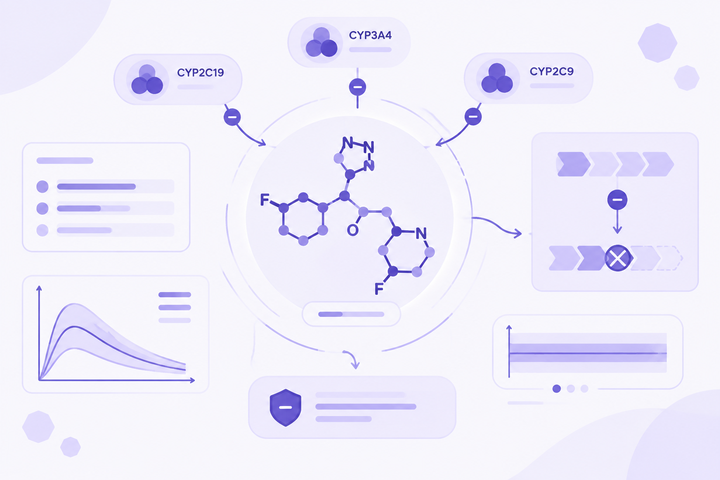
Voriconazole is a triazole antifungal whose primary molecular action involves inhibition of fungal CYP51, also known as 14-alpha-sterol demethylase. This cytochrome P450 enzyme participates in the ergosterol biosynthetic pathway, a fundamental process involved in maintaining fungal cell-membrane composition and function. Voriconazole binding to the fungal enzyme interferes with sterol demethylation, producing depletion of ergosterol and accumulation of precursor sterols. The resulting alteration in membrane lipid composition can impair membrane-associated processes and cellular integrity. This molecular mechanism forms the pharmacodynamic foundation described through PK/PD terminology. The magnitude and duration of antifungal exposure are additionally shaped by metabolism, including substantial involvement of CYP2C19. Consequently, concentration-time descriptors such as half-life and Tmax & Cmax provide complementary pharmacokinetic context for understanding how systemic exposure relates to the molecular target.
The azole mechanism is based on selective interference with fungal sterol biosynthesis rather than direct disruption of the membrane by voriconazole itself. Fungal CYP51 contains a heme iron center that interacts with azole compounds, and voriconazole binding inhibits the enzymatic conversion required during ergosterol production. Ergosterol is a major fungal membrane sterol, so perturbation of its synthesis changes membrane organization, fluidity, permeability, and the function of membrane-associated proteins. The mechanistic sequence can therefore be represented as CYP51 inhibition, altered sterol composition, membrane dysfunction, and impaired fungal cellular processes. The PK/PD framework adds an exposure dimension, while metabolism determines how voriconazole concentrations evolve after systemic absorption. Variability in CYP2C19 activity can contribute to differences in exposure, making pharmacokinetic parameters such as half-life and Tmax & Cmax useful descriptive elements when connecting molecular mechanism with systemic drug behavior.
Voriconazole pharmacology therefore involves two related but distinct CYP concepts: fungal CYP51 as the antifungal molecular target and human hepatic cytochrome P450 enzymes as determinants of drug disposition. Fungal CYP51 inhibition explains the sterol pathway effect, whereas human CYP2C19 activity contributes substantially to metabolism and interindividual exposure variability. Other hepatic pathways also participate in clearance, creating a broader metabolic network. The resulting concentration-time profile can be characterized through half-life, Tmax & Cmax, and broader PK/PD concepts. This distinction is important in mechanistic documentation because enzyme inhibition at the fungal target should not be conflated with metabolic transformation in human tissues. Instead, the two layers interact conceptually: fungal CYP51 determines pharmacodynamic action, while human CYP pathways influence the systemic exposure available to reach that target. This framework also provides context for TDM as an exposure-measurement concept.
Fungal CYP51, or 14-alpha-sterol demethylase, is a cytochrome P450 enzyme positioned within the ergosterol biosynthetic pathway. Voriconazole interacts with the heme-containing catalytic center of CYP51 and interferes with sterol demethylation. This produces reduced formation of ergosterol and accumulation of sterol precursors. The mechanism is therefore target-specific at the enzymatic level, while the downstream cellular consequences involve membrane composition and function. The resulting pharmacodynamic sequence provides the foundation for interpreting antifungal activity through PK/PD concepts.
Ergosterol contributes to fungal membrane organization, influencing membrane fluidity, permeability, and the behavior of membrane-associated proteins. When CYP51 activity is inhibited, the altered sterol profile changes these physical and functional properties. Voriconazole therefore produces its antifungal effect through a biochemical pathway rather than through nonspecific membrane disruption. The distinction between target inhibition and downstream cellular effects is central to mechanistic terminology. It also separates the fungal target from human hepatic metabolism, which governs drug disposition rather than the primary antifungal target.
The sterol pathway can be represented sequentially as substrate conversion, CYP51-mediated demethylation, ergosterol production, and membrane incorporation. Voriconazole interrupts this sequence at the CYP51 step. Subsequent changes in sterol composition provide a mechanistic explanation for impaired membrane-associated functions and altered fungal cellular physiology. The relationship between molecular inhibition and systemic exposure is subsequently described through PK/PD, while concentration behavior can be characterized using half-life and Tmax & Cmax. Exposure variability can additionally reflect CYP2C19-dependent metabolism.
Mechanistic Step
Fungal Target
Documentation Role
Azole binding
CYP51 heme-containing catalytic site
Defines the primary molecular interaction
Sterol demethylation inhibition
14-alpha-sterol demethylase
Explains disruption of ergosterol biosynthesis
Sterol precursor accumulation
Ergosterol pathway intermediates
Documents the biochemical consequence of CYP51 inhibition
Ergosterol depletion
Fungal membrane sterol composition
Connects enzyme inhibition with membrane alteration
Membrane dysfunction
Membrane-associated cellular processes
Describes downstream cellular consequences
Azole Mechanism & Exposure Relationship
Azole antifungals share a mechanistic emphasis on fungal sterol biosynthesis, with CYP51 representing a central enzymatic target. Voriconazole's triazole structure enables interaction with the heme component of fungal CYP51, inhibiting enzymatic activity and altering sterol production. This differs conceptually from antifungal classes that act through other cellular targets. The PK/PD framework connects the concentration of voriconazole with its pharmacodynamic activity, while metabolism influences the concentration-time profile that determines systemic exposure.
Exposure is not synonymous with mechanism: the molecular target remains fungal CYP51, whereas exposure describes how much voriconazole is present over time at systemic and, conceptually, target-relevant concentrations. Pharmacokinetic variables such as half-life and Tmax & Cmax characterize persistence and peak concentration. These parameters can be interpreted alongside PK/PD concepts to describe relationships between exposure and antifungal effect. Variability in exposure can arise from CYP2C19 activity and other aspects of metabolism.
The azole exposure relationship is therefore multidimensional. Molecular affinity for fungal CYP51 establishes target interaction, while systemic pharmacokinetics determine the temporal concentration environment in which that interaction occurs. Human metabolic pathways can modify exposure without changing the fungal target itself. The distinction is particularly relevant when interpreting CYP2C19 interactions, CYP3A4 interactions, and CYP2C9 interactions, because these describe disposition mechanisms rather than alternative antifungal targets. TDM adds an exposure-measurement layer to this mechanistic framework.
Azole Mechanism
Exposure Link
Interpretation
Fungal CYP51 inhibition
Target-relevant voriconazole exposure
Connects molecular binding with antifungal pharmacodynamics
Ergosterol synthesis disruption
Exposure over time
Provides the biochemical bridge between concentration and cellular effect
Human metabolic transformation
Concentration-time profile
Influences systemic exposure without changing the fungal target
CYP-mediated variability
Variable systemic concentrations
Explains differences in observed pharmacokinetic behavior
Exposure measurement
Measured drug concentration
Provides an empirical PK layer for mechanistic documentation
CYP Metabolism & Variability
Voriconazole undergoes extensive hepatic metabolism, with CYP2C19 representing a particularly important pathway. Genetic and phenotypic differences in CYP2C19 activity can contribute to interindividual variability in systemic exposure. Other enzymes also participate, so voriconazole disposition reflects a network rather than a single metabolic reaction. The resulting pharmacokinetic variability can influence concentration-time characteristics, including half-life and Tmax & Cmax. These human CYP processes are mechanistically distinct from fungal CYP51 inhibition.
CYP3A4 and CYP2C9 contribute additional metabolic context. CYP3A4 interactions describe changes involving the CYP3A4 pathway, while CYP2C9 interactions describe interaction mechanisms involving CYP2C9. CYP2C19 interactions similarly describe alterations affecting a major voriconazole metabolic pathway. These interaction categories can modify clearance and systemic exposure through enzyme inhibition or induction. Consequently, metabolism terminology should be distinguished from the antifungal mechanism, which remains centered on fungal CYP51.
The pharmacologic distinction between target CYP51 and metabolic CYP pathways provides an important organizing principle. Fungal CYP51 is inhibited to produce the antifungal effect, whereas human CYP enzymes transform voriconazole and influence its disposition. Changes in metabolic activity can therefore produce different systemic concentration profiles without altering the molecular identity of the antifungal target. The resulting variability can be represented using PK/PD concepts and, where exposure is measured, TDM. This framework explains why CYP-related terminology appears prominently in voriconazole pharmacology documentation.
CYP Pathway
Mechanistic Basis
Exposure Impact
CYP2C19
Major oxidative metabolic pathway with variable activity
Can substantially influence systemic voriconazole exposure
CYP3A4
Contributes to hepatic oxidative metabolism and interaction pathways
Changes in pathway activity can alter concentration profiles
CYP2C9
Participates in voriconazole metabolic disposition
Can contribute to altered clearance and exposure
CYP2C19 interactions
Enzyme inhibition or induction affecting CYP2C19 activity
May modify voriconazole concentrations
Combined CYP effects
Multiple metabolic pathways contribute to disposition
Creates a multidimensional basis for pharmacokinetic variability
Mechanism–PK/PD Integration
Mechanistic pharmacology connects fungal CYP51 inhibition with systemic exposure through the PK/PD framework. The molecular target determines the biochemical pathway affected, whereas pharmacokinetics describe absorption, distribution, metabolism, and elimination. The concentration-time profile can be summarized using half-life and Tmax & Cmax. These parameters do not replace the molecular mechanism; instead, they provide temporal context for the amount of voriconazole available to interact with fungal CYP51.
Voriconazole's pharmacokinetic variability makes the mechanism–exposure relationship particularly important as a documentation concept. Differences in CYP2C19 activity, other metabolic pathways, and interaction effects can produce different concentration profiles. CYP2C19 interactions, CYP3A4 interactions, and CYP2C9 interactions therefore belong to the disposition layer rather than the fungal target layer. TDM represents an empirical method of characterizing systemic concentration, complementing theoretical PK/PD relationships without changing the underlying molecular mechanism.
Mechanism–PK/PD integration can consequently be represented as a sequence: fungal CYP51 inhibition initiates sterol-pathway disruption; systemic exposure determines the concentration-time environment; hepatic metabolism contributes to exposure variability; and measured pharmacokinetic parameters describe that variability quantitatively. The distinction between molecular action and disposition remains essential throughout the framework. Terms such as half-life, Tmax & Cmax, metabolism, and TDM describe exposure behavior, while CYP51 inhibition defines the antifungal mechanism. This separation supports precise pharmacologic documentation.
PK/PD Element
Mechanistic Connection
Documentation Context
CYP51 inhibition
Defines the molecular antifungal target
Provides the starting point for pharmacodynamic interpretation
Systemic exposure
Determines the concentration-time environment
Connects pharmacokinetics with target interaction
Half-life
Describes persistence of systemic drug concentration
Characterizes temporal exposure behavior
Tmax and Cmax
Describe timing and magnitude of peak concentration
Summarize key concentration-time features
TDM
Measures systemic voriconazole concentrations
Provides an empirical exposure-monitoring layer
Frequently Asked Questions
Voriconazole inhibits fungal CYP51, also called 14-alpha-sterol demethylase, a cytochrome P450 enzyme involved in ergosterol biosynthesis. The triazole interacts with the enzyme's heme-containing catalytic center and interferes with sterol demethylation. This reduces ergosterol formation while causing accumulation of precursor sterols. Because ergosterol is an important fungal membrane component, the resulting alteration in sterol composition affects membrane organization and associated cellular functions, providing the biochemical basis of antifungal activity.
The azole mechanism of voriconazole centers on inhibition of fungal sterol biosynthesis rather than direct nonspecific membrane disruption. Voriconazole binds fungal CYP51 and interferes with the enzymatic step required for normal ergosterol production. Reduced ergosterol and altered sterol precursors change fungal membrane composition, influencing membrane fluidity, permeability, and membrane-associated processes. This mechanism distinguishes voriconazole from antifungal classes that act through different cellular targets and explains its classification as a triazole antifungal.
Voriconazole undergoes extensive hepatic metabolism involving several cytochrome P450 pathways, with CYP2C19 having an especially important role. CYP3A4 and CYP2C9 also contribute to metabolic disposition. Differences in enzyme activity can produce variability in systemic voriconazole concentrations and concentration-time profiles. These human CYP pathways are pharmacokinetic mechanisms and should be distinguished from fungal CYP51, which is the molecular antifungal target. Interaction terminology describes how other compounds can alter or be affected by these metabolic pathways.
Mechanism and PK/PD describe complementary levels of voriconazole pharmacology. The mechanism identifies fungal CYP51 as the molecular target and explains disruption of ergosterol biosynthesis. Pharmacokinetics describes absorption, distribution, metabolism, and elimination, while pharmacodynamics relates systemic exposure to antifungal activity. PK/PD terminology therefore connects concentration-time behavior with the target-level effect without replacing the molecular mechanism. Variables such as exposure, peak concentration, persistence, and organism susceptibility can all contribute to this integrated pharmacologic description.
Voriconazole exposure can vary because its disposition depends substantially on hepatic metabolic pathways, particularly CYP2C19, which exhibits meaningful genetic and phenotypic variability. Other metabolic enzymes and interacting compounds can also influence clearance and concentration profiles. The drug additionally displays nonlinear pharmacokinetic characteristics, meaning concentration changes may not always be proportional to changes in administered amount. Consequently, measured systemic concentrations can differ among individuals even when the underlying fungal CYP51 mechanism remains unchanged.
Voriconazole mechanism terminology includes triazole antifungal, fungal CYP51 inhibition, 14-alpha-sterol demethylase inhibition, ergosterol biosynthesis disruption, sterol precursor accumulation, and altered fungal membrane composition. These terms describe different stages of the same biochemical sequence, from molecular target interaction to downstream cellular effects. Mechanism terminology can then be connected with pharmacokinetic and PK/PD terms describing systemic exposure, metabolism, concentration-time behavior, and variability. Keeping these molecular and pharmacokinetic layers distinct improves conceptual clarity.