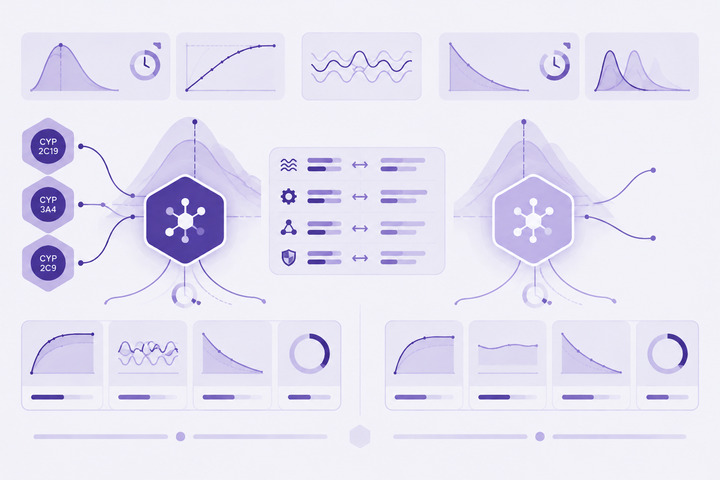
The terminology in a voriconazole vs echinocandins comparison is used here in a PK-contextual sense: it describes how drug input, systemic exposure, distribution, metabolism, and elimination are represented in pharmacokinetic documentation rather than efficacy or clinical decision-making. Voriconazole has oral tablet and oral suspension formulations as well as an IV form, so route and formulation can alter the input phase. Its systemic disposition includes CYP-mediated metabolism, with CYP2C19 phenotype contributing to interindividual variability and exposure behavior that can include nonlinear kinetics. Echinocandins are administered intravenously, producing direct systemic input without an oral absorption phase. Their disposition is characterized by distribution followed by peptide degradation and hepatic pathways with limited dependence on CYP metabolism. These distinctions provide a framework for describing bioavailability, absorption variability, and exposure metrics without assigning clinical value.
In mechanistic documentation, voriconazole and echinocandins can therefore be separated by the relationship between formulation, input rate, and subsequent systemic disposition. Oral voriconazole requires gastrointestinal absorption before systemic exposure is established, whereas intravenous administration bypasses gastrointestinal absorption. The resulting exposure profile can be described using bioavailability, absorption variability, distribution volume concepts, metabolic pathways, and clearance. Echinocandins lack an oral formulation in routine pharmaceutical presentation and are introduced directly into systemic circulation, making bioavailability terminology route-specific rather than an absorption determinant. Their molecular class is composed of cyclic lipopeptides with hepatic and extrahepatic degradation pathways that differ from the CYP-dominant framework used for voriconazole. The contrast is also visible in Tmax & Cmax, where route of administration strongly influences the meaning of observed concentration-time features. These descriptors characterize exposure timing and magnitude; they do not by themselves establish efficacy, safety, superiority, or treatment suitability.
Temporal and variability terminology adds another layer to the comparison. Voriconazole can display concentration-dependent changes in exposure because metabolic capacity becomes an important determinant of systemic concentrations, while CYP2C19 genetic phenotype is one source of between-subject variability. Echinocandin pharmacokinetics are instead commonly characterized around intravenous input, distributional behavior, hepatic processing, and molecular degradation, with individual agents showing some class heterogeneity in elimination and dose-exposure relationships. The half-life describes the terminal decline of concentration and should be distinguished from distribution phases or effective persistence within a compartment. TDM is a documentation term referring to measured drug concentrations and exposure interpretation, not a recommendation to perform monitoring. Similarly, toxicity overview terminology can describe reported adverse-event or exposure-association concepts without assigning causality or management. In this framework, comparison means mechanistic characterization of PK processes, not ranking the agents or directing their use.
A mechanistic comparison begins by separating drug input from drug disposition. Voriconazole has both oral and intravenous routes, so its systemic exposure can be conceptualized as the combined result of formulation-dependent input, gastrointestinal absorption when administered orally, systemic availability, distribution, metabolism, and clearance. The bioavailability descriptor is particularly relevant to oral formulations because it expresses the fraction of administered material reaching systemic circulation relative to an appropriate reference. Echinocandins, by contrast, are administered intravenously, so their systemic input is direct and an oral absorption phase is not part of the standard formulation pathway. This distinction changes the meaning of absorption variability: for voriconazole it can represent differences in gastrointestinal input, whereas for echinocandins the term is generally not applicable to routine administration. Subsequent exposure remains describable through concentration-time profiles, distribution, metabolism, clearance, and terminal disposition regardless of route.
The second foundation is disposition mechanism. Voriconazole undergoes hepatic biotransformation involving several cytochrome P450 enzymes, with CYP2C19 representing an important source of pharmacogenetic variability. Its exposure can demonstrate nonlinear kinetics, meaning that changes in input or concentration do not necessarily translate into strictly proportional changes in systemic exposure. Echinocandins have a different molecular architecture and are generally processed through hepatic and degradative pathways involving peptide or lipopeptide handling rather than CYP2C19-dependent oxidative metabolism. Individual echinocandins are not pharmacokinetically identical, so class-level language should distinguish shared IV input and broadly non-CYP disposition from agent-specific clearance characteristics. These mechanisms affect how interindividual variability is categorized. A documented concentration difference can reflect input, distribution, metabolic capacity, clearance, sampling time, or residual variability, and the observed concentration alone does not identify a single causal mechanism.
Mechanistic terminology also requires separation of measured descriptors from interpretation. Distribution describes movement between plasma and tissue compartments, while clearance represents the apparent volume of plasma from which drug is removed per unit time. Tmax & Cmax characterize timing and magnitude of observed concentration peaks, whereas half-life describes the temporal decline associated with a specified kinetic phase. These terms can be compared between voriconazole and echinocandins without assigning clinical value. Similarly, TDM terminology denotes measurement and interpretation of drug concentrations as PK observations rather than an instruction to monitor. Spectrum terminology and indications terminology can also appear as descriptive metadata, but neither should be converted into efficacy ranking or clinical guidance. The central comparison therefore concerns how formulation, systemic input, metabolic pathways, distribution, and elimination shape the documented concentration-time profile.
| Comparison Term | Voriconazole Basis | Echinocandin Basis |
|---|---|---|
| Systemic input | Oral or IV, with route-dependent input characteristics. | IV-only systemic input. |
| Bioavailability | Relevant to oral administration and route comparison. | Not an oral absorption descriptor for IV-only administration. |
| Metabolic architecture | CYP-mediated hepatic biotransformation. | Hepatic and degradative peptide/lipopeptide processing with limited CYP dependence. |
| Variability framework | Includes absorption, metabolic phenotype, nonlinear exposure, and clearance variability. | Includes distribution, clearance, physiologic covariate, and agent-specific variability. |
| Temporal descriptors | Tmax, Cmax, and half-life depend on route and disposition. | Temporal descriptors reflect IV input, distribution, and terminal disposition. |
Formulation is a primary determinant of the input phase for voriconazole. Oral tablet and oral suspension presentations introduce a gastrointestinal absorption sequence involving dosage-form disintegration or dispersion, dissolution, intestinal uptake, and systemic availability. These processes create an absorption phase before systemic concentrations are observed and provide a mechanistic basis for discussing formulation-dependent bioavailability and absorption variability. The IV form bypasses gastrointestinal absorption and places the drug directly into systemic circulation, changing the input function while leaving downstream distribution, metabolism, and clearance processes relevant. Thus, a difference between oral and IV concentration-time profiles cannot be described solely as a difference in disposition; the route also changes the preceding input process. Documentation can distinguish formulation effects from intrinsic disposition effects by identifying the route, formulation, sampling schedule, and concentration-time context.
Echinocandins provide a contrasting input architecture because the class is administered intravenously. Direct systemic administration removes oral dissolution, gastrointestinal transit, and intestinal absorption as routine determinants of systemic exposure. The concentration-time profile is instead influenced by the administered input function, infusion characteristics, distribution into vascular and extravascular compartments, protein binding, and subsequent elimination. The absence of an oral formulation means that conventional oral bioavailability comparisons are not directly applicable within routine class-level documentation. Nevertheless, formulation remains relevant because pharmaceutical composition and molecular presentation can influence distribution, infusion-related input, and observed concentration behavior. Class-level terminology should therefore avoid assuming that all echinocandins have identical PK profiles. Shared IV administration is a formulation characteristic, whereas clearance, tissue distribution, metabolic degradation, and terminal half-life remain agent-specific properties.
A useful documentation distinction is between input variability and disposition variability. For orally administered voriconazole, input variability may encompass differences in absorption rate, extent of absorption, gastrointestinal conditions, and formulation characteristics. For IV voriconazole and echinocandins, input variability is more closely related to administration and infusion parameters rather than gastrointestinal uptake. Once systemic circulation is reached, the relevant descriptors shift toward distribution, metabolic transformation, clearance, and terminal elimination. This separation is important when interpreting Cmax or Tmax because a concentration peak can be altered by the rate and route of input independently of intrinsic clearance. It also prevents the use of bioavailability terminology as a generic synonym for overall exposure. In mechanistic PK documentation, formulation, route, input function, systemic availability, and disposition should remain distinct variables.
| Formulation/Input Factor | Voriconazole | Echinocandins |
|---|---|---|
| Oral formulation | Tablet and oral suspension provide gastrointestinal input followed by systemic absorption. | No routine oral formulation; administration is intravenous. |
| IV formulation | Direct systemic input bypasses gastrointestinal absorption. | Primary administration route provides direct systemic input. |
| Bioavailability terminology | Relevant when comparing oral systemic availability with an IV reference. | Oral bioavailability is not a defining routine PK descriptor. |
| Absorption variability | Can contribute to variability after oral administration. | Not a routine determinant after IV administration. |
| Input-phase descriptors | Route and formulation influence input rate and observed concentration timing. | Infusion and administration characteristics influence the systemic input function. |
Systemic exposure represents the concentration-time experience generated after drug reaches the circulation. For voriconazole, exposure variability can arise from several mechanistic layers: formulation-dependent input, oral absorption, metabolic phenotype, CYP-mediated clearance, distribution, and nonlinear disposition. Interindividual variability therefore does not represent one single process. A difference in observed concentration may reflect altered systemic availability, absorption rate, metabolic capacity, clearance, sampling time, or combinations of these factors. The absorption variability concept is particularly relevant to oral voriconazole because the administered dose must pass through an absorption phase before reaching systemic circulation. By contrast, echinocandins have direct IV input, so variability is more strongly framed around distribution, protein binding, hepatic processing, physiologic covariates, and agent-specific clearance. These distinctions allow exposure variability to be described without assigning clinical significance to a particular concentration or exposure pattern.
The terminology of interindividual variability and intraindividual variability also helps structure pharmacokinetic documentation. Interindividual variability describes differences between subjects, potentially involving body size, age-related physiology, organ function, genetic phenotype, interacting substances, distribution characteristics, and metabolic capacity. For voriconazole, CYP2C19 phenotype is a recognized mechanistic contributor to between-subject differences in metabolism. Intraindividual variability refers to changes within the same subject across different sampling periods or conditions and may involve formulation, administration, physiologic state, interacting factors, or other time-varying determinants. Echinocandin exposure variability can likewise involve subject-level covariates, but its mechanistic framework is less centered on CYP2C19 phenotype. Because class members differ, a single class-level statement should remain descriptive rather than treating all echinocandins as pharmacokinetically interchangeable.
Exposure descriptors such as area under the concentration-time curve, Cmax, and trough concentration are observations that summarize different portions of a concentration-time profile. Cmax emphasizes peak magnitude, while area-under-the-curve concepts integrate exposure over time; neither descriptor independently identifies the mechanism responsible for variability. Tmax reflects the timing of a measured peak and can be especially route-dependent for voriconazole. For IV-only echinocandins, the interpretation of peak timing is tied to infusion and sampling design rather than gastrointestinal absorption. TDM terminology may be used when measured concentrations are incorporated into a PK dataset, but the existence of TDM data does not imply a management action. Mechanistic documentation is strongest when route, formulation, sampling time, assay characteristics, dose history, concentration metric, and relevant covariates are recorded alongside the exposure observation.
| Exposure Variable | Voriconazole | Echinocandins |
|---|---|---|
| Interindividual variability | Can reflect formulation, absorption, CYP2C19 phenotype, metabolism, clearance, and physiologic covariates. | Can reflect body size, distribution, clearance, hepatic processing, and agent-specific covariates. |
| Intraindividual variability | May reflect changing input, metabolic state, formulation, interacting factors, or sampling conditions. | May reflect changing physiologic state, administration conditions, distribution, or clearance. |
| Peak exposure | Cmax can depend on route, absorption, input rate, distribution, and nonlinear disposition. | Cmax depends on IV input, infusion, distribution, and agent-specific disposition. |
| Integrated exposure | AUC reflects systemic exposure across a defined time interval. | AUC reflects systemic exposure across a defined time interval. |
| Variability terminology | Absorption, metabolic, phenotype-related, clearance, and residual variability can be distinguished. | Distribution, clearance, physiologic-covariate, agent-specific, and residual variability can be distinguished. |
Voriconazole metabolism is organized around hepatic CYP-mediated biotransformation, with CYP2C19, CYP3A4, and CYP2C9 contributing to oxidative metabolism. CYP2C19 is particularly relevant to pharmacogenetic terminology because phenotype differences can alter metabolic capacity and contribute to between-subject exposure variability. The metabolic pathway therefore links genotype or phenotype concepts with systemic concentration behavior without requiring an outcome interpretation. Voriconazole also exhibits nonlinear PK characteristics over relevant concentration ranges, meaning that metabolic capacity and pathway saturation can affect the relationship between input and observed exposure. The metabolism and CYP2C19 descriptors should consequently be separated from clearance as a general term: metabolism describes biochemical transformation, whereas clearance describes the overall apparent removal process from the measured compartment.
Echinocandins use a different disposition architecture. They are cyclic lipopeptides and are not principally eliminated through CYP2C19-dependent oxidative metabolism. Instead, individual agents undergo hepatic processing, hydrolysis, degradation, biliary handling, and other molecular elimination processes to varying degrees. This is often summarized with non-CYP or peptide-clearance terminology, but the class should not be treated as a single uniform metabolic pathway. Some echinocandins have predominantly nonenzymatic or enzymatic degradation characteristics, while others involve hepatic metabolism and biliary or fecal elimination. Their exposure profiles are generally more compatible with approximately proportional PK descriptions than the characteristic nonlinear framework of voriconazole, although agent-specific deviations and covariate effects remain possible. The mechanistic contrast is therefore between CYP-sensitive oxidative disposition and peptide/lipopeptide degradation rather than between two identical clearance models.
Nonlinear kinetics should also be distinguished from ordinary PK variability. A nonlinear relationship concerns the mathematical relationship between dose or input and exposure, whereas variability concerns differences among observations or individuals. Voriconazole can show nonlinear behavior because its metabolic pathways contribute disproportionately as concentrations change. Echinocandin class members generally have more predictable proportionality over studied ranges, but the exact relationship depends on the individual compound and experimental conditions. Clearance terminology remains useful for both groups, yet the determinants differ: voriconazole clearance is closely connected to hepatic metabolic capacity, whereas echinocandin clearance reflects hepatic processing, degradation, distribution, and compound-specific elimination. This distinction supports neutral documentation of metabolic phenotype, pathway contribution, intrinsic clearance, apparent clearance, and exposure proportionality without converting those descriptors into recommendations or clinical judgments.
| Metabolic Factor | Voriconazole | Echinocandins |
|---|---|---|
| Primary metabolic framework | CYP-mediated hepatic oxidative metabolism. | Hepatic and degradative processing of cyclic lipopeptide structures. |
| CYP2C19 | Relevant contributor to metabolic phenotype and interindividual PK variability. | Not a principal pathway for class-level disposition. |
| Other CYP pathways | CYP3A4 and CYP2C9 also contribute to metabolism. | CYP-mediated oxidative metabolism is not the principal clearance mechanism. |
| Nonlinear kinetics | Exposure can show nonlinear behavior associated with concentration-dependent metabolism. | Class members are generally described as more proportional, with agent-specific kinetic differences. |
| Clearance concept | Apparent clearance incorporates hepatic metabolic capacity and other disposition processes. | Clearance incorporates hepatic processing, degradation, distribution, and agent-specific elimination. |
Distribution describes the movement of drug between the measured vascular compartment and other tissues or compartments. Voriconazole distribution is influenced by physicochemical properties, protein binding, tissue partitioning, and the relationship between plasma and extravascular concentrations. Echinocandins are also distributed beyond plasma, but their high protein binding and molecular properties create distinct distribution characteristics that vary among class members. A measured plasma concentration therefore represents one compartmental observation rather than a direct measurement of every tissue concentration. Compartment models can describe these processes using central and peripheral volumes, intercompartmental clearance, distribution phases, and terminal disposition. The distribution descriptor should consequently be kept separate from elimination terminology. A rapid initial concentration decline can reflect distribution rather than irreversible removal, while a terminal phase can reflect combined redistribution and elimination processes.
Clearance provides another common comparison point. Voriconazole clearance is substantially influenced by hepatic metabolic transformation and can vary with CYP2C19 phenotype, CYP activity, interacting factors, and nonlinear concentration behavior. Echinocandin clearance is generally linked to hepatic processing and degradation rather than CYP2C19-dependent metabolism, with compound-specific pathways producing different apparent clearance profiles. The resulting terminal half-life can therefore reflect different mechanistic processes even when the same mathematical descriptor is used. Half-life is calculated from the relationship between concentration decline and the relevant elimination or terminal rate constant; in multicompartment systems, it does not necessarily represent a single biochemical reaction. Comparing half-life values without considering route, distribution, sampling duration, and kinetic model can therefore obscure the underlying disposition architecture.
Tmax and Cmax provide temporal and magnitude descriptors that are particularly sensitive to input conditions. For oral voriconazole, Tmax reflects the combined effects of formulation, absorption rate, and systemic disposition, while Cmax reflects the resulting peak concentration after absorption and distribution. With IV voriconazole, peak timing is instead associated with the administration or infusion input function. For IV-only echinocandins, conventional absorption-related Tmax is not applicable, and the timing of measured maximum concentration depends on infusion and sampling conventions. These distinctions are important when documenting concentration-time profiles. TDM data can provide measured concentration observations for either group, but concentration measurement does not itself establish a clinical action. Temporal descriptors should remain descriptive variables that support reconstruction of exposure profiles rather than serving as standalone indicators of efficacy, safety, or treatment selection.
| PK Descriptor | Voriconazole | Echinocandins |
|---|---|---|
| Distribution | Influenced by protein binding, tissue partitioning, physicochemical properties, and multicompartment behavior. | Strong protein binding and agent-specific tissue distribution contribute to multicompartment disposition. |
| Clearance | Closely associated with hepatic CYP-mediated metabolism and variable metabolic capacity. | Associated with hepatic processing, degradation, and agent-specific elimination pathways. |
| Tmax | Route-dependent; oral Tmax incorporates absorption, whereas IV timing reflects administration input. | No gastrointestinal absorption Tmax; observed peak timing is linked to IV input and sampling. |
| Cmax | Influenced by formulation, systemic availability, absorption rate, distribution, and nonlinear disposition. | Influenced by IV input, infusion, distribution, and compound-specific disposition. |
| Half-life | Terminal half-life reflects the relevant terminal concentration decline. | Terminal half-life reflects multicompartment distribution and compound-specific elimination. |
PK documentation benefits from separating observed measurements from mechanistic interpretation. For voriconazole, a complete record can distinguish formulation, route, administered input, sampling time, concentration assay, bioavailability context, absorption characteristics, metabolic pathway terminology, CYP2C19 phenotype, clearance, and kinetic model. For echinocandins, documentation can similarly distinguish the specific class member, IV formulation, infusion conditions, sampling time, protein-binding context, distribution model, hepatic processing, degradation pathways, and apparent clearance. This level of detail matters because the same numerical concentration can arise from different combinations of input and disposition variables. A mechanistic comparison therefore should not treat concentration as a direct proxy for a single physiological process. The TDM term can describe concentration-based PK data, while uncertainty can be documented through assay variability, sparse sampling, model assumptions, missing covariates, or incomplete exposure histories.
Comparative interpretation also requires attention to terminology that can appear similar while representing different concepts. Bioavailability refers to systemic availability relative to an appropriate reference, whereas absorption variability concerns differences in the gastrointestinal input process. Clearance refers to apparent removal capacity, whereas metabolism identifies biochemical transformation. Nonlinear kinetics describes a departure from proportional dose-exposure relationships, whereas interindividual variability describes differences between observations or subjects. For voriconazole, CYP2C19 phenotype can be incorporated into the metabolic variability framework. For echinocandins, non-CYP peptide or lipopeptide disposition terminology better represents the class-level mechanistic distinction, although individual compounds require compound-specific descriptions. Spectrum and indications terminology can be retained as neutral descriptive metadata when relevant to documentation, but those labels should not be interpreted as recommendations, comparative efficacy claims, or clinical-use instructions.
Uncertainty is an intrinsic part of PK interpretation when concentration-time data are incomplete. Sampling near a peak may characterize Cmax but provide limited information about the terminal phase; sparse sampling can make half-life estimation model-dependent; and route changes can make oral and IV profiles non-equivalent input conditions. Formulation changes may alter the absorption phase without necessarily changing intrinsic clearance, while changes in metabolic phenotype or hepatic processing can alter systemic disposition independently of formulation. For echinocandins, class-level statements can obscure differences between individual agents, so compound identity should accompany mechanistic interpretation. A neutral documentation framework therefore records what was measured, when it was measured, how drug entered systemic circulation, which kinetic model was used, and which covariates were available. Such documentation supports transparent PK description without converting uncertainty into a risk category or clinical recommendation.
| Interpretation Factor | Voriconazole | Echinocandins |
|---|---|---|
| Formulation context | Route and formulation affect input and oral absorption terminology. | IV-only administration makes infusion and formulation input central. |
| Metabolic context | CYP-mediated metabolism, including CYP2C19 phenotype, can be documented. | Non-CYP hepatic and degradative processing is the principal class-level framework. |
| Model uncertainty | Nonlinear disposition can complicate simple proportional exposure assumptions. | Class heterogeneity means agent-specific PK models may be required for precise description. |
| Sampling uncertainty | Sparse or mistimed samples can affect Cmax, Tmax, and terminal-phase interpretation. | Sparse or mistimed samples can affect peak and terminal-phase characterization. |
| Documentation scope | Route, formulation, assay, sampling time, metabolic context, and covariates are relevant descriptors. | Specific agent, IV input, sampling time, distribution, clearance, and covariates are relevant descriptors. |
A PK comparison describes differences in drug input, systemic exposure, distribution, metabolism, clearance, and concentration-time behavior. It does not inherently compare efficacy or recommend one agent. For voriconazole, oral and IV routes create distinct input processes and CYP-mediated metabolism is important. Echinocandins are IV-only and use predominantly non-CYP hepatic and degradative disposition pathways.
Voriconazole has oral and intravenous input pathways, substantial CYP-mediated hepatic metabolism, CYP2C19-related variability, and nonlinear exposure characteristics. Echinocandins are administered intravenously and generally undergo hepatic or degradative processing with limited dependence on CYP oxidation. Their pharmacokinetic profiles also differ among individual class members, so class-level descriptions should not imply identical clearance, distribution, or temporal behavior.
Voriconazole formulations include oral and intravenous presentations. Oral administration introduces gastrointestinal dissolution, absorption, and bioavailability as additional PK processes, whereas IV administration bypasses gastrointestinal absorption. Echinocandins are administered intravenously, so routine systemic exposure does not include an oral absorption phase. Consequently, formulation-related differences can affect input timing and magnitude before downstream distribution and clearance are considered.
Voriconazole undergoes hepatic CYP-mediated oxidative metabolism involving CYP2C19, CYP3A4, and CYP2C9. Echinocandins have a different molecular architecture and are principally processed through hepatic and degradative pathways involving peptide or lipopeptide handling. CYP2C19 is therefore a relevant mechanistic variable for voriconazole but not a principal class-level determinant of echinocandin disposition.
CYP2C19 contributes to voriconazole metabolism, so genetic or phenotypic differences in CYP2C19 activity can contribute to between-subject differences in metabolic capacity and systemic exposure. This is described as pharmacogenetic or metabolic variability. The concept is distinct from absorption variability, formulation variability, and clearance variability, although these mechanisms can interact within an observed concentration-time profile.
Nonlinear kinetics describes a mathematical relationship in which exposure does not change proportionally with input across a specified range. Voriconazole can display nonlinear exposure behavior associated with its metabolic pathways. Peptide or lipopeptide clearance describes molecular processing mechanisms relevant to echinocandins. These are different concepts: one characterizes exposure proportionality, while the other describes disposition and elimination pathways.
Tmax describes the observed time of maximum concentration, Cmax describes the observed peak concentration, and half-life describes the decline associated with a defined kinetic phase. For oral voriconazole, Tmax incorporates absorption and input characteristics. For IV-only echinocandins, peak timing depends on infusion and sampling. Half-life can reflect multicompartment distribution and terminal disposition rather than one biochemical process.
Uncertainty can arise from sparse sampling, assay variation, incomplete dosing histories, formulation changes, route differences, unmeasured covariates, model assumptions, and incomplete characterization of distribution or terminal phases. Voriconazole also has metabolic and nonlinear considerations, while echinocandins show agent-specific disposition differences. A neutral PK interpretation therefore distinguishes measured observations from inferred mechanisms and records the limitations of available concentration-time data.
Spectrum terminology can describe the broad pharmacologic range of fungal targets associated with voriconazole or the echinocandin class. In a mechanistic PK document, that terminology is contextual rather than a recommendation. It should not be used to infer comparative efficacy, clinical suitability, superiority, or treatment selection. PK interpretation remains focused on formulation, systemic exposure, distribution, metabolism, clearance, and variability.
Indications terminology can function as descriptive metadata identifying categories in which a medicine or class has documented or labeled use. In a neutral PK comparison, such terminology does not constitute clinical indication guidance. It should remain separate from pharmacokinetic observations such as exposure, clearance, half-life, or variability and should not be used to infer efficacy, preference, risk, or treatment decisions.